
- Description
- Can This Spinach & Cream Cheese Stuffed Salmon Support Weight Loss Goals?
- Does Spinach & Cream Cheese Stuffed Salmon Fit a High-Protein Lifestyle?
- My Personal Experience
- Perfect For
- Why You'll Love This Recipe
- Common Mistakes to Avoid
- Required Equipment
- Storage Instructions
- Recipe Details
- Short Description 📝
- 📝 Ingredients
- Directions
- Nutrition Facts (Per Serving – Approximate)
- Notes
- Frequently Asked Questions
Description
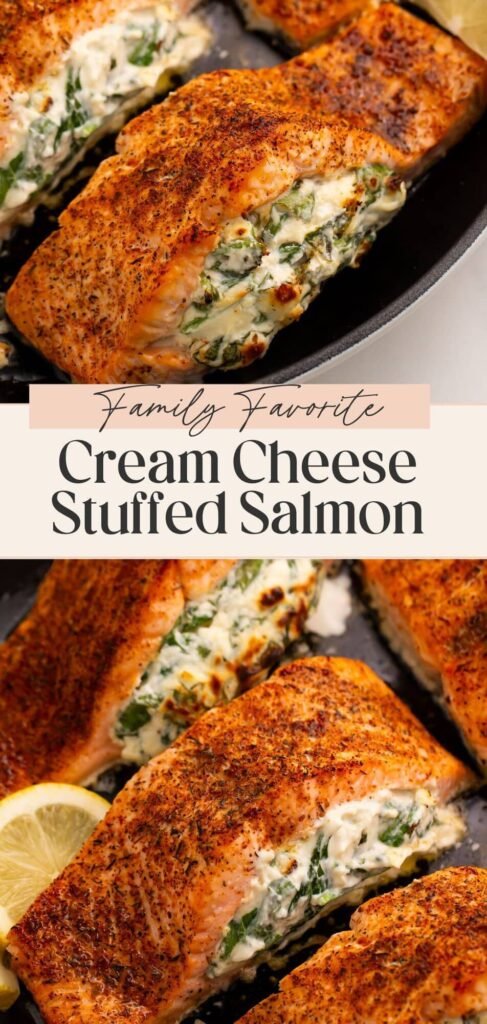
This Spinach & Cream Cheese Stuffed Salmon combines tender, flaky salmon with a creamy, garlicky spinach and cream cheese filling. The rich filling melts beautifully into the salmon while Parmesan adds a savory, slightly nutty finish.
With naturally high protein and relatively low carbohydrates, this stuffed salmon is an easy choice for anyone looking for satisfying low-carb recipes without sacrificing flavor. It feels indulgent enough for a special dinner but is simple enough for a weeknight meal.
Can This Spinach & Cream Cheese Stuffed Salmon Support Weight Loss Goals?
It can fit into a weight-loss-oriented eating pattern when enjoyed as part of an overall calorie-controlled diet. Salmon provides substantial protein, which can contribute to a satisfying meal, while spinach adds volume and nutrients without adding many carbohydrates. Cream cheese and Parmesan provide richness, so keeping portions appropriate can help balance the recipe’s overall calorie content. Individual weight-loss needs vary, so this recipe should be considered one option within a balanced eating pattern rather than a weight-loss treatment.
Does Spinach & Cream Cheese Stuffed Salmon Fit a High-Protein Lifestyle?
Yes, this recipe is well suited to a high-protein lifestyle because salmon is the primary ingredient and provides most of the recipe’s protein.
The spinach, cream cheese, and Parmesan create a creamy filling while keeping the carbohydrate content relatively modest.
At approximately 4–5 g net carbs per serving, it can work well for many low-carb meal plans.
For a higher-protein meal, pair it with a protein-rich side such as Greek yogurt-based sauce or simply increase the salmon portion.
My Personal Experience
Note: These are written in a first-person recipe-blog style; personalize them to reflect your own experience if needed.
- The filling makes the salmon feel extra special.
I love how the creamy spinach mixture stays tucked inside the salmon while baking, giving every bite a rich and savory texture. - It is surprisingly easy to prepare.
Once the spinach filling is mixed, the main cooking step is simply stuffing and baking the salmon until it flakes easily. - The combination feels satisfying without being carb-heavy.
The salmon provides plenty of protein, while spinach and a modest amount of cream cheese keep the meal comforting without relying on pasta, rice, or breadcrumbs. - The leftovers are convenient for meal prep.
I find that properly stored portions make an easy next-day lunch when gently reheated to avoid drying out the salmon.
Perfect For
- High-protein recipes and balanced weeknight dinners
- Low-carb recipes for lunch or dinner
- Keto diet plans that fit the recipe’s carbohydrate allowance
- High-protein meal-prep menus
- Easy family dinners
- Dinner parties and special occasions
- Summer grilling-season meals when paired with a fresh salad
- Cozy winter dinners served with roasted low-carb vegetables
- Anyone looking for a protein-rich alternative to pasta or rice-based meals
Why You’ll Love This Recipe
- Creamy spinach filling in every bite.
Cream cheese, Parmesan, garlic, and spinach create a rich filling that complements the naturally buttery flavor of salmon. - High in protein naturally.
Salmon is the star ingredient, making this a convenient protein-focused meal without needing protein powders or specialty ingredients. - Low in carbohydrates.
The recipe skips breadcrumbs, flour, pasta, and other traditional fillers, keeping the estimated net carbs relatively low. - Weeknight friendly.
The filling comes together quickly, and the salmon cooks in the oven while you prepare a simple side dish. - Restaurant-style presentation.
A slit filled with creamy spinach gives ordinary salmon an attractive stuffed appearance with minimal extra effort.
Common Mistakes to Avoid
- Overstuffing the salmon — Too much filling can spill out during cooking and make the salmon harder to close. Use enough filling to generously fill the pocket without forcing it open.
- Overcooking the salmon — Salmon can become dry when cooked too long. Start checking early and remove it when the thickest part is just cooked and flakes easily.
- Leaving excess moisture in the spinach — Watery spinach can make the filling runny. Squeeze or cook off excess moisture before combining it with the cream cheese.
- Cutting the salmon immediately after baking — Allowing it to rest for about 5 minutes helps the juices settle and makes the filling less likely to spill out.
Required Equipment
- Large skillet — Quickly wilts the spinach and cooks the garlic evenly.
- Sharp chef’s knife — Creates a clean pocket in each salmon fillet.
- Cutting board — Provides a stable surface for preparing the salmon safely.
- Mixing bowl — Makes combining the creamy spinach filling easy.
- Baking sheet or baking dish — Holds the stuffed salmon securely during baking.
- Parchment paper — Helps reduce sticking and simplifies cleanup.
- Instant-read thermometer — Helps prevent accidentally overcooking the salmon.
Storage Instructions
Refrigerator: Allow leftovers to cool slightly, then place them in an airtight container and refrigerate within about 2 hours. Properly refrigerated stuffed salmon is best enjoyed within 3 days.
Freezer: For longer storage, wrap individual portions tightly in plastic wrap or freezer-safe material and place them in an airtight freezer container or freezer bag. Use within approximately 2 months for the best texture and flavor.
Reheating: Thaw frozen portions overnight in the refrigerator. Reheat refrigerated salmon gently in a covered oven-safe dish at 300°F (150°C) for about 10–15 minutes, or until heated through. Avoid high heat because it can dry out the salmon and cream cheese filling.
Recipe Details
- Preparation Time: 15 minutes
- Cooking Time: 18–22 minutes
- Total Time: 33–37 minutes
- Servings: 4
- Best Season for This Recipe: All-season
- Total Calories: Approximately 510 calories per serving
Short Description 📝
Tender salmon is filled with creamy spinach, garlic, cream cheese, and Parmesan for a rich yet simple dinner.
This high-protein, low-carb recipe delivers satisfying flavor without breadcrumbs or pasta.
It’s an easy weeknight meal that also works beautifully for meal prep or entertaining.
📝 Ingredients
For the Salmon
- 4 salmon fillets, about 6 oz (170 g) each, skinless and boneless
- 1 tablespoon olive oil
- ½ teaspoon salt
- ¼ teaspoon black pepper
- ½ teaspoon paprika
- ½ teaspoon Italian seasoning
For the Spinach & Cream Cheese Filling
- 4 oz (113 g) cream cheese, softened
- 4 cups fresh baby spinach, roughly chopped
- ¼ cup (25 g) grated Parmesan cheese
- 2 cloves garlic, finely minced
- 1 tablespoon olive oil
- ¼ teaspoon salt
- ¼ teaspoon black pepper
- ½ teaspoon lemon zest
- 1 tablespoon fresh lemon juice
Ingredient note: Full-fat or reduced-fat cream cheese can be used. Reduced-fat cream cheese will lower the overall calories and fat slightly. Fresh spinach is preferred, but frozen spinach can also work if thoroughly thawed and squeezed dry.
Directions
1. Preheat the oven
Preheat the oven to 400°F (200°C). Line a baking sheet or baking dish with parchment paper.
A fully preheated oven helps the salmon cook evenly and develop a lightly roasted exterior.
2. Prepare the spinach
Heat 1 tablespoon olive oil in a large skillet over medium heat.
Add the minced garlic and cook for about 30 seconds, just until fragrant. Add the chopped spinach and cook for 2–3 minutes, stirring frequently, until wilted.
Remove from the heat and let the spinach cool for a few minutes.
High-protein tip: Avoid adding unnecessary breadcrumbs or flour to the filling; the cream cheese and Parmesan provide enough structure and richness.
3. Make the creamy filling
In a mixing bowl, combine the softened cream cheese, Parmesan, cooked spinach and garlic, lemon zest, lemon juice, salt, and black pepper.
Mix until creamy and evenly combined. The filling should be thick enough to sit inside the salmon without running.
4. Cut the salmon pockets
Pat the salmon fillets dry with paper towels.
Using a sharp knife, carefully cut a horizontal pocket through the thickest part of each fillet, stopping before cutting completely through the other side.
Texture cue: Keep the outer edges intact so the filling stays inside during baking.
5. Stuff the salmon
Divide the spinach and cream cheese mixture evenly among the four salmon fillets.
Gently press the filling into each pocket without overstuffing. Brush or rub the salmon with 1 tablespoon olive oil, then season with salt, pepper, paprika, and Italian seasoning.
6. Bake
Place the stuffed salmon on the prepared baking sheet.
Bake at 400°F (200°C) for approximately 18–22 minutes, depending on the thickness of the fillets.
The salmon should look opaque and flake easily with a fork. For the most reliable result, check the thickest portion with an instant-read thermometer and cook to your preferred safe doneness.
7. Rest and serve
Remove the salmon from the oven and let it rest for 5 minutes.
Serve warm with lemon wedges, roasted broccoli, asparagus, a leafy green salad, or another low-carb vegetable.
High-protein cooking tip: Pairing the salmon with a non-starchy vegetable keeps the meal protein-focused without adding a large amount of carbohydrate.
Nutrition Facts (Per Serving – Approximate)
| Nutrient | Amount |
|---|---|
| Calories | ~510 kcal |
| Fat | ~33 g |
| Cholesterol | ~125 mg |
| Sodium | ~600 mg |
| Potassium | ~1,000 mg |
| Total Carbohydrates | ~6 g |
| Fiber | ~1.5 g |
| Net Carbs | ~4.5 g |
| Sugars | ~2 g |
| Protein | ~45 g |
| Calcium | ~170 mg |
Nutrition note: These figures are approximate estimates calculated from typical ingredient values. Actual nutrition will vary according to salmon size, cream cheese brand, Parmesan, seasoning amounts, and other ingredients used.
Notes
- Storage: Refrigerate leftovers in an airtight container for up to 3 days. Freeze individually wrapped portions for up to approximately 2 months.
- Reheating: Reheat gently at 300°F (150°C) until warmed through to help preserve the salmon’s moisture.
- Allergy note: This recipe contains fish and dairy. Use dairy-free cream cheese and Parmesan alternatives if appropriate for your dietary needs, while noting that the nutritional values will change.
- Flavor boost: Add red pepper flakes for heat, extra lemon zest for brightness, or a small amount of fresh dill or parsley before serving.
- Creamier filling: Let the cream cheese soften at room temperature before mixing so it combines smoothly with the spinach.
- Lower-calorie option: Reduced-fat cream cheese can be substituted, although it may slightly change the texture and flavor.
- Meal-prep tip: Store salmon and vegetables in separate compartments when possible to maintain the best texture.
Frequently Asked Questions
1. Can I use frozen spinach?
Yes, but thaw it completely and squeeze out as much excess water as possible before mixing it into the cream cheese.
2. Can I prepare the stuffed salmon ahead of time?
Yes, you can assemble the salmon several hours ahead, cover it, refrigerate it, and bake it when ready.
3. Is this recipe low-carb?
Yes, the recipe contains approximately 4.5 g net carbohydrates per serving, although exact values vary by ingredients and brands.
4. Is stuffed salmon high in protein?
Yes, this recipe provides approximately 45 g of protein per serving, primarily from the salmon.
5. Can I use another cheese instead of Parmesan?
Yes, finely grated mozzarella, Asiago, or Romano can be substituted, although each will slightly change the flavor and nutrition.
6. What vegetables pair well with stuffed salmon?
Broccoli, asparagus, zucchini, green beans, cauliflower, or a fresh leafy salad all complement the creamy salmon while keeping the meal relatively low in carbohydrates.