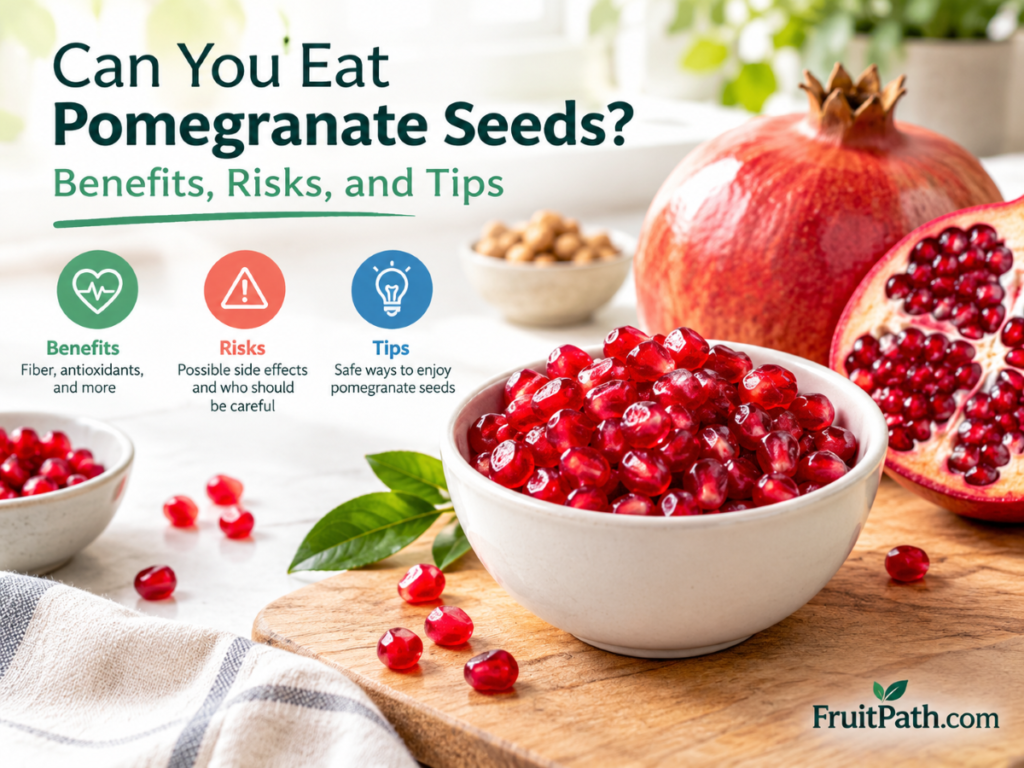
You cut open a pomegranate and find hundreds of shiny red jewels. Each one holds a tiny, crunchy seed. Do you spit it out? Do you swallow it? Is it even safe?
Good news: you can eat pomegranate seeds. Most people do, and the seeds provide much of the fruit’s fiber. In this guide, you’ll learn what’s safe, what the research says, and who should be careful. We also cover pregnancy, weight loss, night snacking, yogurt, and old fruit.
Quick answer: Yes, you can eat pomegranate seeds. The juicy red part is called the aril, and the small crunchy seed inside it is edible too. Healthline says the seeds are safe for most people. Very large amounts may cause a blockage in rare cases, mostly in people with serious, ongoing constipation. If you take blood thinners or statins, or you are pregnant, ask your doctor first. The research on those cases is mostly about juice, not seeds.
Pomegranate seeds are edible and provide fiber. Enjoy them on their own or add them to yogurt, oatmeal, and salads.
Yes, the seeds are edible. You can chew them or swallow them.
They are rich in fiber. About 4 grams per 100 grams of arils, according to USDA data.
Weight loss: a large review found a small drop in body weight, but it studied juice, extract, and seed oil, not whole seeds.
Side effects are usually mild, like loose stools or an upset stomach. Allergies are uncommon but real.
Skip the peel, root, and stem. Health sources say they may not be safe in large amounts.
Check with your doctor if you take warfarin or a statin, or if you are pregnant.
Can You Eat Pomegranate Seeds?
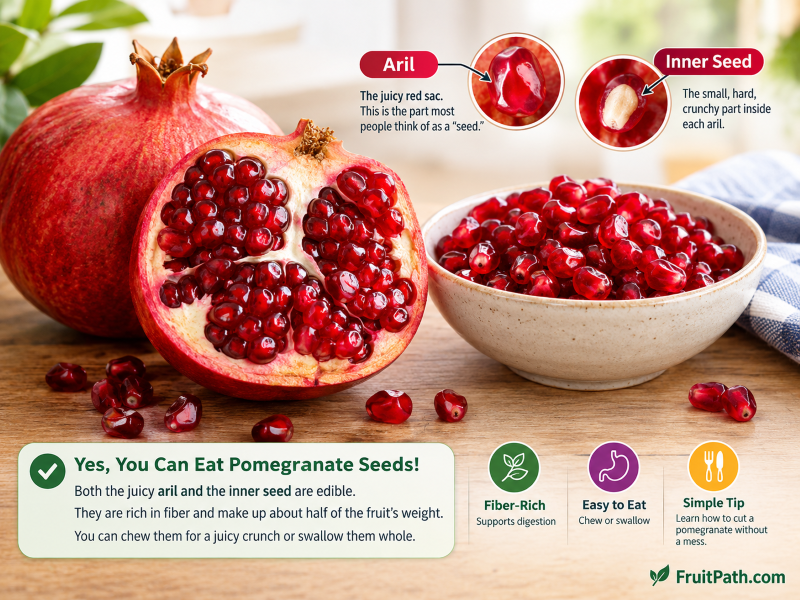
Yes. First, let’s clear up the terms, because people use “seed” to mean two different things.
The aril is the juicy red sac. It is the part most people think of as a “seed.”
The inner seed is the small, hard, crunchy part inside each aril.
You can eat both together. Healthline says pomegranate seeds are edible and make up about half the fruit’s weight. The Pomegranate Council, a group that promotes the fruit, also calls the seeds fiber-rich.
Do you have to chew them? No. You can chew them for a juicy crunch or swallow them whole. Healthline says your body doesn’t break down the seeds’ main fibers, so they pass through your digestive system. That’s how fiber works.
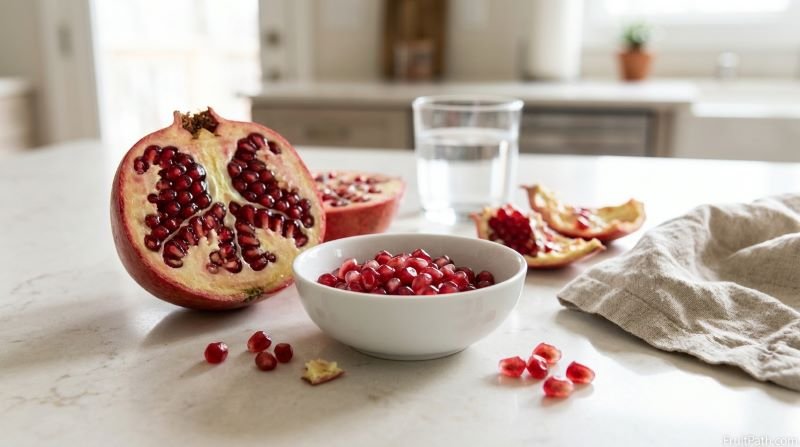
Both the juicy red aril and the crunchy inner seed of a pomegranate are edible and provide fiber. Learn how to enjoy pomegranate seeds and add them to your daily meals with FruitPath.com.
Can You Eat Pomegranate Seeds? Benefits:
Short answer: They provide fiber, vitamins, and plant compounds, with very little fat.
Here is what a serving of seeds offers. These numbers come from the USDA data we used in ourpomegranate nutrition facts post.
Calories: about 83 per 100 grams, or about 72 in a half cup
Fiber: about 4 grams per 100 grams
Vitamins and minerals: vitamin K, vitamin C, folate, and potassium
Sugar: about 13.7 grams per 100 grams, all natural
Why fiber matters. The Mayo Clinicsays fiber helps prevent constipation and supports a healthy weight. It is also linked to a lower risk of diabetes and heart disease.
What about the oil in the seeds? Healthline says the inner seed is about 12% to 20% oil, mostly a fat called punicic acid. Animal studies suggest it may calm inflammation and help the body handle blood sugar. Some small human studies exist, but Healthline says more research is needed. Think of this as interesting, not proven.
Antioxidants. Healthline notes that the seeds also have antioxidants, but fewer than the juicy arils. The fruit is a healthy addition to your meals. It is not a cure for anything.
Can You Eat Pomegranate Seeds for Weight Loss?
Short answer: They can fit a weight-loss plan, but they will not melt fat on their own.
Here is the balanced picture.
What helps: Pomegranate seeds are low-calorie for a sweet fruit, and the fiber helps you feel full. A half cup is only about 72 calories.
What the research says: A 2023 review in Food Science & Nutrition looked at 28 trials with 1,124 adults. On average, people who took pomegranate lost about 2 kilograms (roughly 4 pounds) more than the comparison groups. Their BMI dropped a little too. But waist size did not change meaningfully.
The catch: The trials used pomegranate juice, extract, and seed oil. The review’s trial list had no whole-fruit studies. The studies were also small and short (2 to 24 weeks), and some had a high risk of bias. So we cannot say eating the seeds causes weight loss.
A simple way to use them: Add half a cup to yogurt, oatmeal, or a salad instead of a sugary snack. That is a smart swap. The swap helps, not the pomegranate by itself.
Pomegranate seeds provide fiber and make a delicious, portion-friendly snack. Enjoy them with yogurt, oatmeal, or salad as part of a balanced weight-loss plan.
Eating Pomegranate Seeds Side Effects:
Short answer: Most people have none. When they happen, they are usually mild stomach problems.
Loose stools or diarrhea. Memorial Sloan Kettering lists diarrhea as a possible side effect of pomegranate juice. Too much fiber from any food can upset your stomach.
Blockage in rare cases. Healthline says eating a very large amount of seeds may, in rare cases, cause an intestinal blockage. The risk is higher in people with chronic constipation.
Allergy. NCCIH reports allergic reactions to pomegranate. Stop eating and get medical help if you have trouble breathing, swelling, or a rash.
Natural sugar. The seeds are sweet. If you watch your blood sugar, keep your portion small.
Never eat the peel, root, or stem. NCCIH says they may not be safe in large amounts, andMemorial Sloan Kettering says to avoid eating them. Stick to the arils and the seeds inside them.
Pomegranate seeds are safe for most people, but large amounts may cause digestive discomfort. Enjoy moderate portions and avoid the peel, root, and stem.
Who Should Not Eat Pomegranate Seeds?
Short answer: Most people can eat them. A few groups should be careful or ask a doctor first.
Anyone with a pomegranate allergy. Skip the fruit completely.
People with severe or long-lasting constipation. Healthline says this group has a higher risk of blockage with large amounts of seeds. If this is you, ask your doctor before eating a lot.
People who take warfarin (a blood thinner). Memorial Sloan Kettering says pomegranate juice may increase bleeding risk.
People who take statins (cholesterol medicine). Memorial Sloan Kettering says juice may raise the risk of a muscle problem called rhabdomyolysis in people on statins.
People with diabetes. Memorial Sloan Kettering says to be careful because of the fruit’s sugar. Ask your doctor or dietitian how it fits your plan.
People who want to take pomegranate supplements. Memorial Sloan Kettering says to talk to your health care provider first.
An important note: The medicine warnings above come from studies and case reports on juice. I did not find a source that tested whole seeds with these medicines. So we cannot say that a handful of seeds is risky. But if you take any of these medicines and eat pomegranate often, tell your doctor. That is the safe choice.
Can You Eat Pomegranate Seeds While Pregnant?
Short answer: It may be fine, but there is no strong proof either way for the seeds. Ask your doctor or midwife.
Here is what we know.
NCCIH says drinking pomegranate juice during pregnancy or while breastfeeding “may be safe.” It also says that little is known about whether other forms of pomegranate are safe.
NCCIH doesn’t address eating the whole fruit directly, so it doesn’t give a clear yes or no on the seeds.
A small 2013 study from Washington University School of Medicine gave pregnant women in late pregnancy 8 ounces of pomegranate juice a day. It examined lab markers in placental tissue. The study was tiny, with only 12 tissue samples, and it did not show that juice prevents any pregnancy problem.
So the sources I found don’t give a clear yes or no on eating the seeds, and the research is thin. Stick to normal food portions, avoid the peel, root, and stem, and skip supplements unless your doctor says yes. Every pregnancy is different, so check with your care provider.
Research on whole pomegranate seeds during pregnancy is limited. Ask your doctor or midwife for advice tailored to your pregnancy.
Can You Eat Pomegranate Seeds at Night?
Short answer: Yes, there is no known rule against it—amount and comfort matter more than the time.
I didn’t find any research saying pomegranate seeds are better or worse at night. So here is plain common sense, not a study.
Seeds have fiber and natural sugar. A big bowl late at night may feel heavy for some people.
If you get stomach upset or heartburn at night, try a smaller portion or eat earlier.
A half cup is a light snack at about 72 calories.
Listen to your own body. If it feels fine, it is fine.
Can You Eat Pomegranate Seeds With Yogurt?
Short answer: Yes. It is one of the easiest and tastiest ways to eat them.
Try this:
Spoon plain yogurt into a bowl.
Add a half cup of pomegranate seeds on top.
Add a pinch of nuts or a little honey if you like.
The seeds add a sweet-tart pop and a crunch. Plain yogurt keeps the sugar lower than flavored cups do. To keep the seeds crunchy, add them right before you eat. Ourpomegranate storage guideshows how to keep extra seeds fresh in the fridge for a few days.
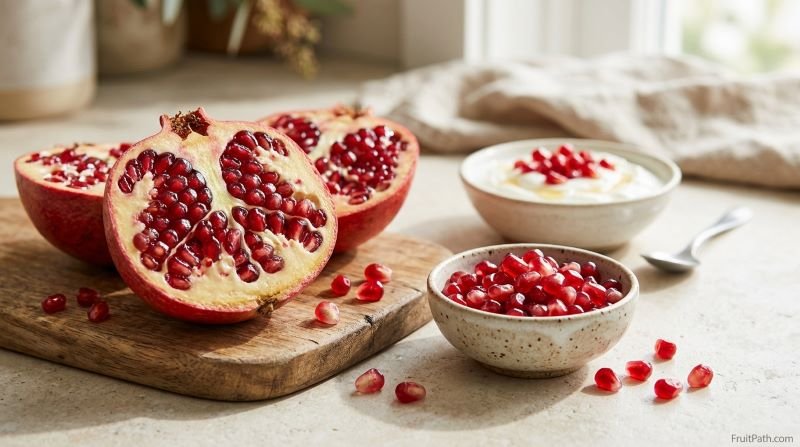
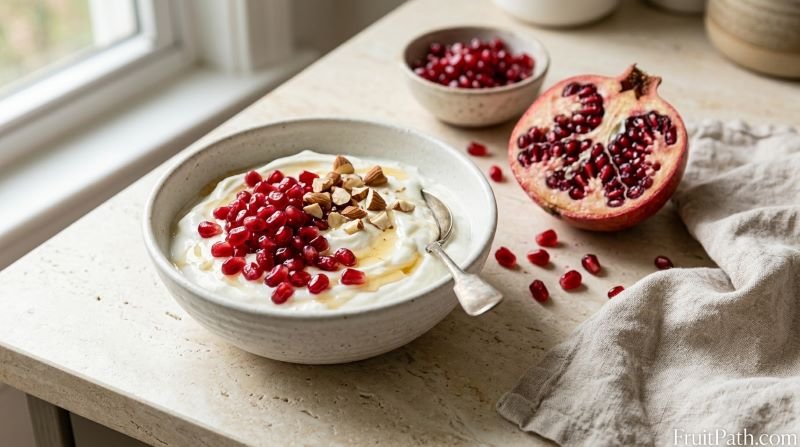
Add half a cup of fresh pomegranate seeds to plain yogurt for a creamy, crunchy snack with a naturally sweet-tart flavor.
Can You Eat Pomegranate Seeds After the Use-By Date?
Short answer: Use your eyes and nose first. If you see mold or smell something sour, throw it out.
A date on a package is a guide. A whole pomegranate usually does not have one. Packaged seeds from the store do, and a date doesn’t tell you everything about how the seeds were stored. Here is a safe way to check, using the tips from our storage post.
Mold: The University of California describes blue and green mold as wet-looking spots that turn into a green or blue-green powder.
Smell: A sour, sharp, or alcohol-like smell is a warning sign.
Look and feel: Dry, dull, or slimy seeds have gone past their best.
Time: Loose seeds only last about 3 to 5 days in the fridge, though sources vary. The Pomegranate Council says up to 3 days.
If you find mold inside a whole fruit, throw it away. Mold can spread inside where you cannot see it. And the old rule still holds: when in doubt, throw it out.
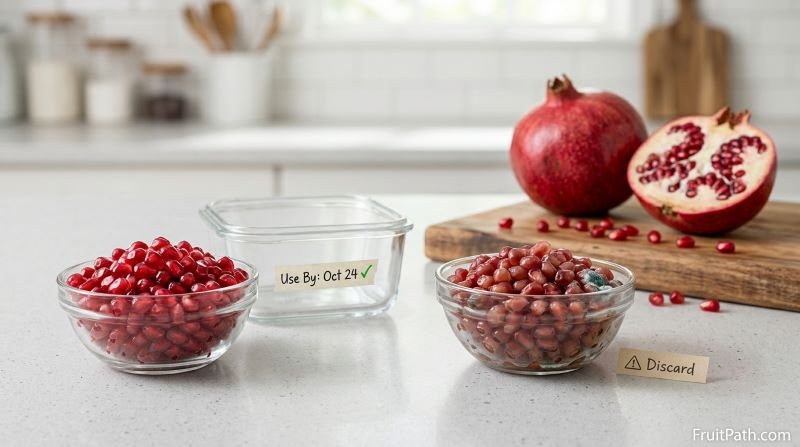
Check pomegranate seeds for mold, sliminess, dullness, and unusual odors. When in doubt, throw them out.
How Many Pomegranate Seeds Can You Eat a Day?
I did not find an official daily limit. Most recipes and nutrition guides use about a half cup (about 87 grams) as a normal serving, and we use that serving in our nutrition facts post. Start there. If you feel fine, you can eat more. If you get loose stools or stomach pain, eat less.
Tips for Eating Pomegranate Seeds:
Chew them for more flavor. Chewing releases the juice and the crunch.
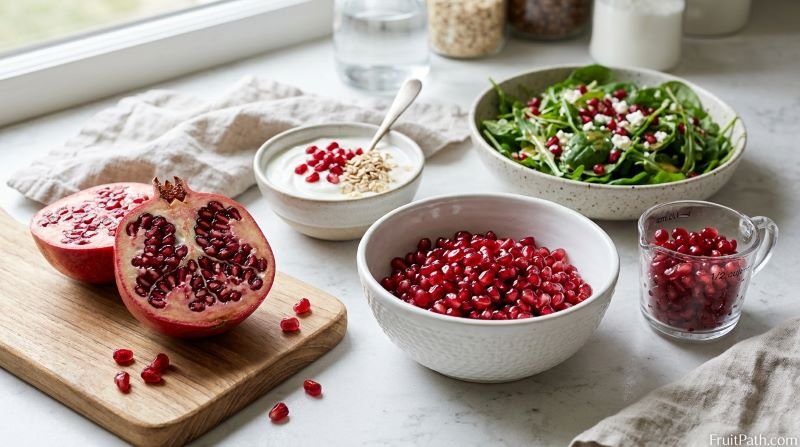
Sprinkle them on food. Try salads, oatmeal, rice, tacos, or desserts.
Buy in season. Fresh fruit is easiest to find in fall and winter. See our pomegranate season guide.
Try the variety you like. Some fruits are softer-seeded; others are crunchier. See our guide to pomegranate varieties.
Frequently Asked Questions:
Can you eat pomegranate seeds?
Yes. The juicy red part (the aril) and the small crunchy seed inside it are both edible. Healthline says the seeds are safe for most people. You can chew them or swallow them whole. Do not eat the peel, root, or stem.
Do you chew pomegranate seeds or swallow them?
Either way is fine. Chewing gives you more juice and crunch. If you swallow them whole, the seed’s fiber passes through your digestive system, according to Healthline.
Can you eat pomegranate seeds for weight loss?
They can fit a weight-loss plan because they are low in calories and have fiber. A half cup has about 72 calories. A 2023 review of 28 trials found a small weight drop, but those trials used juice, extract, and seed oil, not whole seeds. They will not cause weight loss on their own.
What are the side effects of eating pomegranate seeds?
Most people have none. Some get loose stools or stomach upset. Healthline says very large amounts may cause a blockage in rare cases, mostly in people with chronic constipation. Allergic reactions are uncommon but have been reported.
Who should not eat pomegranate seeds?
Anyone with a pomegranate allergy should avoid them. People with severe constipation should be careful. If you take warfarin or a statin, ask your doctor, because the warnings come from studies on juice. People with diabetes should watch their portion because of the sugar.
Can you eat pomegranate seeds when pregnant?
It may be fine, but the research on seeds is thin. NCCIH says drinking pomegranate juice during pregnancy may be safe, but little is known about other forms. Avoid the peel, root, stem, and supplements, and check with your doctor or midwife.
Can you eat pomegranate seeds at night?
Yes. I found no research that says timing matters. A half cup is a light snack. If large portions give you stomach upset or heartburn at night, eat less or eat earlier.
Can you eat pomegranate seeds with yogurt?
Yes. Add a half cup of seeds to plain yogurt right before eating so they stay crunchy. Add nuts or a little honey if you like.
Can you eat pomegranate seeds after the use-by date?
Check them first. Throw them out if you see mold, smell something sour or sharp, or find them slimy. Loose seeds last only a few days in the fridge, and mold can spread inside a whole fruit. When in doubt, throw it out.
Final Thoughts:
So, can you eat pomegranate seeds? Yes. The aril and the seed inside are both safe for most people, and the seed adds extra fiber. Keep your portion to about half a cup, skip the peel, root, and stem, and pay attention to how your stomach feels.
If you are pregnant, have a pomegranate allergy, or take warfarin or a statin, talk to your doctor first. Health questions are personal, and this guide is for general information, not medical advice.