

Picture a bright orange-red flower on a green bush. A few months later, that flower turns into a round red fruit full of juicy seeds. That is the pomegranate tree at work. You can grow one at home if you have enough sun and mild winters.
In this guide, you will learn how to grow a pomegranate tree, how long it takes to bear fruit, how long the tree lives, and what climate it prefers. You will also see how many trees fit on an acre and what the numbers say about whether pomegranate farming pays. We also cover pots, growth stages, splitting fruit, and what to do if your tree has flowers but no fruit.
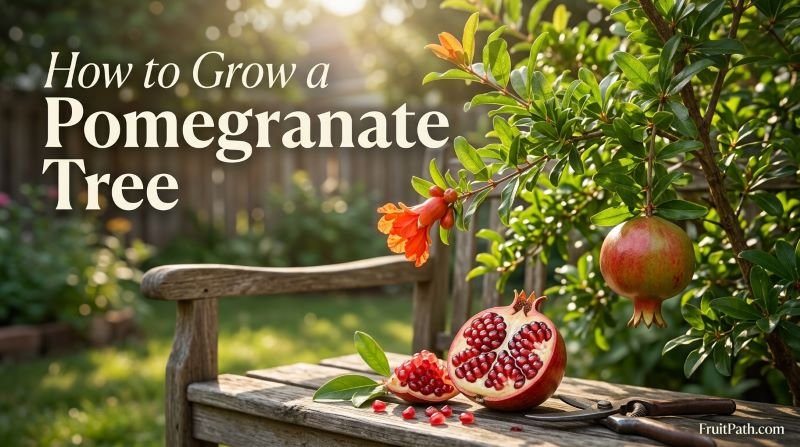
Quick answer: A pomegranate tree grows best in full sun, well-drained soil, and hot summers with cool winters. Most types grow outdoors in USDA zones 8 to 11. It usually starts to flower in its second or third year, fruit ripens about 5 to 7 months after the flowers bloom, and full production often takes 5 to 6 years. A tree can live for many decades, and the University of Georgia says it can live up to 200 years.
- Key Takeaways:
- What Is a Pomegranate Tree?
- Pomegranate Growing Climate and Zones:
- How to Grow a Pomegranate Tree:
- How to Plant a Pomegranate Tree:
- How to Plant Pomegranate Seeds:
- Pomegranate Plant Growth Stages:
- Pomegranate Fruit Growing Time: How Long Until It Is Ripe?
- How Long Does a Pomegranate Tree Take to Fruit?
- Life of a Pomegranate Tree: How Long Does It Live?
- Pomegranate Tree in a Pot:
- Pomegranate Tree Care: Water, Food, and Pruning:
- Pomegranate Tree Not Fruiting: 7 Common Reasons:
- Why Do Pomegranates Split on the Tree?
- Common Pests and Diseases:
- How Many Pomegranate Trees Per Acre?
- Is Pomegranate Farming Profitable?
- Pomegranate Farming Profit Per Acre:
- What to Do With Your Harvest:
- Frequently Asked Questions:
- Final Thoughts:
- Sources:
Key Takeaways:
- Climate: hot summers and cool winters. Most types grow outdoors in zones 8 to 11, and some in zone 7 with shelter.
- Sun: at least 6-8 hours of direct sun per day.
- Time to fruit: flowers often start in year 2 or 3. Full production often takes 5 to 6 years.
- Fruit growing time: fruit ripens about 5 to 7 months after bloom, and it does not ripen after picking.
- Tree life: it can live for many decades. A California cost study assumed a 25-year working life for an orchard.
- Trees per acre: about 134 at wide spacing and 200 or more at closer spacing.
- Farming profit: it depends on yield, price, and costs. The examples below range from small profits to large incomes.
What Is a Pomegranate Tree?
The pomegranate (Punica granatum) is a woody plant that drops its leaves in winter. It often grows as a bushy shrub, but you can train it to be a small tree.
The University of Florida’s extension service (UF/IFAS) says it is usually a shrub 6 to 12 feet tall. You can train it as a small tree that reaches 12 to 20 feet. The flowers are orange-red and about 1.5 to 2.5 inches wide. According to the University of Georgia, the branches are thorny.
New to the fruit itself? Before we get into growing it, start with our complete pomegranate fruit guide.
Pomegranate Growing Climate and Zones:
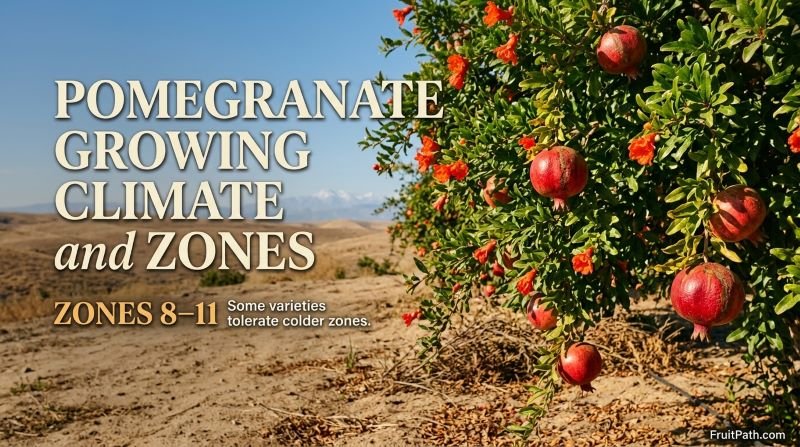
Short answer: Hot summers, cool winters, and dry weather during fruit growth. Zones 8 to 11 for most types.
Zones. The USDA hardiness zone map shows the lowest winter temperatures where a plant can live.
- Epic Gardening (updated December 2025) says pomegranates grow in zones 8 to 11.
- Garden.org says most types are hardy to zones 8 to 11, and zone 7 can work in a protected spot, like a south-facing wall. It says dwarf forms are hardy to zone 7. It also names two varieties, ‘Salavatski’ and ‘Kazake’, that it says survive zone 6 winters. I couldn’t verify that claim in a second source, so test it locally before you rely on it.
- A 2026 Grow Organic guide says many types grow in zones 7 to 10.
So the exact range depends on the variety. If you live in a colder place, grow a dwarf tree in a pot, as noted below.
Cold. The UF/IFAS guide says a dormant tree can be badly hurt at 12°F (-11°C). The University of Georgia agrees that most types are hardy to about 12°F and says the hardiest survive to about 7°F without damage.
Heat. The University of Georgia says pomegranate trees are very heat tolerant and do best with temperatures above 85°F for at least 120 days a year. They are drought tolerant once established, but they need water while establishing, and water is “critical” for commercial fruit.
Farm climate numbers. India’s National Horticulture Board says a suitable temperature range is about 25 to 35°C, with about 500 to 800 mm of rain a year. It says plants are harmed if temperatures stay below 11°C for long periods. It also says dry weather during fruit growth improves quality, while humid weather during fruit setting hurts color and quality and increases pest and disease risk.
UF/IFAS puts it: the best fruit comes from places with cool winters and hot, dry summers.
How to Grow a Pomegranate Tree:
Short answer: For growing a pomegranate tree, here is the basic procedure:
| Sun | At least 6 to 8 hours of direct sun a day. Epic Gardening says at least 8. |
| Soil | Well-drained soil. UF/IFAS says deep loam is best, but it adapts from sand to heavy clay. |
| Soil pH | About 5.5 to 7.0 (UF/IFAS). Garden.org says up to 7.5. Alkaline soil can cause nutrient problems. |
| Water | About 50 to 60 inches a year, which is roughly 1 inch a week, counting rain. |
| Spacing | Hedge: 6 to 9 feet apart. Single trees or orchards: about 10 to 18 feet apart (see the trees-per-acre section). |
| Pruning | Light. Do it in late winter. |
Pomegranates also prefer soil that does not stay soggy. Poor drainage often causes young trees to struggle.
How to Plant a Pomegranate Tree:
Short answer: Plant in early spring, in a hole twice as wide as the roots, and water well.
- Pick the time. UF/IFAS suggests early spring (February to March in Florida), after the risk of a late frost.
- Pick the spot. Choose full sun and well-drained soil.
- Dig the hole. Epic Gardening says to dig the hole about twice as wide and as deep as the root ball.
- Mix in compost. Mix compost into the soil you dug out, and put half of that mix back in the hole.
- Set the tree. Plant it at the same level it sat in its pot. Loosen any circling roots.
- Fill and press. Backfill and gently press the soil to remove air pockets.
- Water and mulch. Water deeply. Add mulch, but keep it at least 4 inches away from the trunk.
Buying tip: Buy a named fruiting variety, not a plant sold only for flowers. For more options, our guide to pomegranate varieties can help you choose.

How to Plant Pomegranate Seeds:
Short answer: It works, but the fruit will not match the parent, and cuttings are the better choice. If you want to start from seed anyway, the next steps explain how.
UF/IFAS says plants grown from seed do not come true to type. The UF propagation page agrees: seeds can produce variable seedlings, while cuttings are true to type. So seeds are fine for fun or for breeding, but not if you want a certain variety.
If you still want to try, the University of Florida’s citrus research center (UF/CREC) gives these steps:
- Get the seeds out of the juicy part. Roll the seeds in a paper towel to remove the aril, then rinse them well.
- Dry them. Let them dry for 30 minutes to a couple of hours. You can refrigerate them for up to a few weeks.
- Sow them. Plant them ½ to 1 inch deep in ordinary potting mix. Keep it moist and warm.
- Keep them warm. UF/CREC says temperatures of 75 to 85°F are important for germination.
- Move them later: Transplant when seedlings are about 4 to 6 inches tall.
I couldn’t find a reliable germination time or success rate, so I won’t guess. According to UF/CREC, freshly cleaned seeds may sprout less often than treated ones.
How long until a seed-grown tree fruits? Sources differ. The University of Georgia says seed-grown trees take at least three years to bear. UF/CREC calls the juvenile period “relatively short (1 to 2 years)” but says seedlings may take longer to flower than cuttings.
Cuttings are easier and truer. The University of Georgia prefers hardwood cuttings. UF/IFAS suggests cuttings 6 to 8 inches long, about pencil-thick, taken in winter, with 2 to 4 buds above the soil. UF/CREC says rooting takes 4 to 8 weeks in warm conditions, with success of about 60% to 85%. Buying a young named tree from a nursery is the easiest path.

Pomegranate Plant Growth Stages:
Short answer: Roots and growth in year one, first flowers in year two or three, and full production around year five or six. After that, the tree repeats the cycle each year.
Sources do not give one official list of stages, so this table puts together what they say. To keep the timing clear, the cycle below follows the seasons.
| 1. Planting and rooting | Year 1 | The tree settles in and grows roots and branches. Epic Gardening says trees do not flower in year one. Water regularly. |
| 2. First flowers | Year 2 to 3 | Orange-red flowers appear. Some become small fruit. UF/IFAS says heavy fruit drop is common in the young years. |
| 3. First harvest | About year 3 | The University of Georgia says the first harvest is small and late-maturing. |
| 4. Full production | About year 5 to 6 | Georgia says full commercial production begins around year 5 or 6, and that trees reach maturity in 5 to 7 years. |
| 5. Yearly cycle | Every year | See below. |
The yearly cycle for a mature tree (Georgia dates; other regions differ):
- Winter: the tree rests and drops its leaves.
- Spring: new growth appears, and flowers start. Bloom runs from April to June, in one or in three to four flushes.
- Summer: flowers turn into fruit that grows bigger.
- Late summer and fall: fruit ripens. Early types start in late August, and late types run through October or early November. Plan for two to four pickings.
Pomegranate Fruit Growing Time: How Long Until It Is Ripe?
Short answer: About 5 to 7 months from bloom to ripe fruit.
The California Rare Fruit Growers say fruit matures about 5 to 7 months after bloom, depending on weather and variety. Epic Gardening gives the same range. That fits the Georgia dates: bloom in April to June leads to ripe fruit from late August into November.
UF/IFAS says fruit matures from July to November in North Florida. In South Florida, it may produce year-round. Most U.S. fruit is harvested in fall. See our pomegranate season guide for exact months worldwide.
One important rule: pomegranates do not ripen after picking. Leave them on the tree until they are fully ripe—our guide on how to see if a pomegranate is ripe shows what to look for.
How Long Does a Pomegranate Tree Take to Fruit?
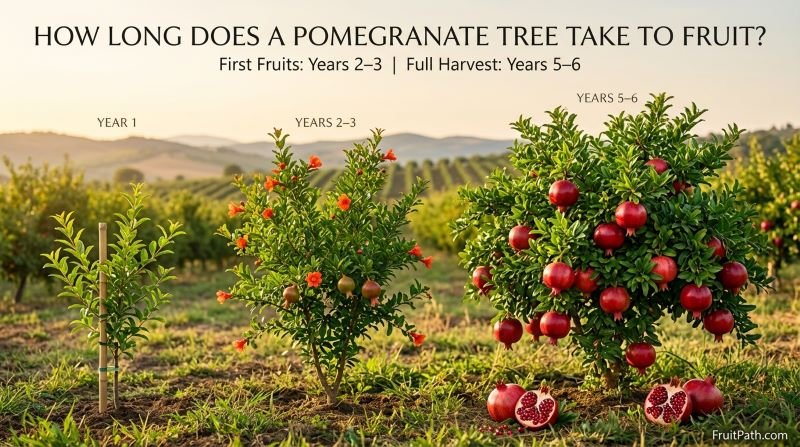
Short answer: First flowers and a few fruits often come in year 2 or 3. A good harvest usually comes in year 5 or 6.
Sources agree on the general range, though they use different words. To compare them clearly, here are the main cases.
- Cuttings: The University of Georgia says trees from hardwood cuttings can bear in year two after planting, and the first harvest comes in year three.
- Seed: Georgia says at least three years.
- Nursery trees: Epic Gardening says shrubs and trees usually take at least 2 to 3 years to mature. Grow Organic says a nursery tree may fruit in two to three years, with heavier harvests as it matures.
- A real crop: Garden.org says year 4 or 5. Georgia says full commercial production starts in year 5 or 6.
- Young-tree drop: UF/IFAS says heavy fruit drop is common while the tree is young (3 to 5 years).
So if your young tree drops its first fruits, don’t panic. This is normal. Garden.org says a mature tree in a good climate can carry 50 to 100 fruits or more in a good year.
Life of a Pomegranate Tree: How Long Does It Live?
Short answer: Many decades. The University of Georgia says they can live up to 200 years.
Here is the difference between how long a tree lives and how long it earns its keep. Next, look at when it starts paying back.
- Lifespan. Georgia says pomegranate trees reach maturity in five to seven years and can live up to 200 years. Grow Organic says only that they can fruit for “many years.”
- Working life on a farm. A 2010 University of California cost study assumed a 25-year orchard life. India’s National Horticulture Board model ran its numbers over 15 years. These are planning numbers, not limits on how long a tree can live.
With light pruning and good care, a home tree can last a very long time.

Pomegranate Tree in a Pot:
Short answer: Yes. Pick a dwarf variety, use a large pot, and bring it in for winter.
Growing in a pot is the best option if you live in zone 7 or colder.
- Pick a dwarf. Garden.org names ‘Nana’ and ‘Chico’ as dwarf types that grow 3 to 4 feet tall. Epic Gardening also suggests ‘Nana’ for containers.
- Choose a big pot. Garden.org recommends at least 20 inches deep and drainage holes. For overwintering, it suggests 15 to 20 gallons for a dwarf.
- Use the right soil. Use a free-draining potting mix, like a citrus or fruit-tree mix.
- Water and feed. Water when the top inch of soil is dry. Garden.org recommends feeding every three to four weeks with a balanced liquid fertilizer.
- Overwinter. Move the pot to an unheated garage or a bright, cool spot before nights near freezing. The plant will go dormant and drop its leaves. Water only enough to keep the soil from drying out completely. In spring, move it back outside slowly.
A word of warning: Epic Gardening says indoor pomegranates rarely fruit. Keep the plant outside in full sun during the growing season.
Pomegranate Tree Care: Water, Food, and Pruning:
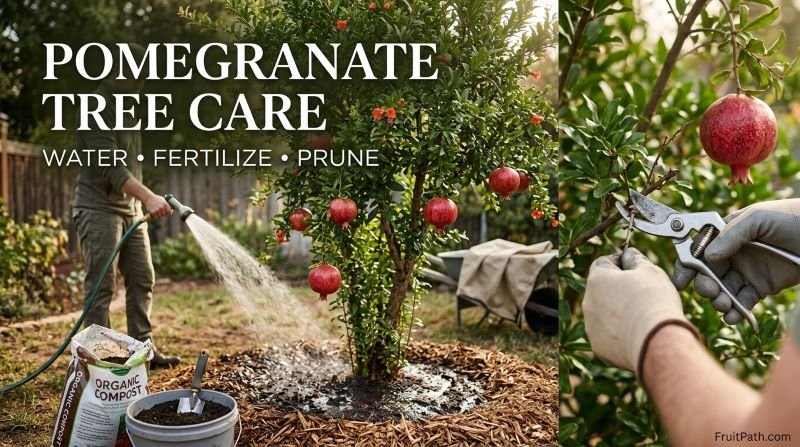
Watering. Water regularly in the first season. Once the tree is settled, water deeply but not too often. UF/IFAS recommends watering every 7 to 10 days when there is no good rain, and tapering off as fruit matures. The key is steady water. Sudden changes cause problems (see splitting below).
Fertilizing. Go easy. Epic Gardening says not to fertilize in year one, then to use a small amount in early spring and early fall in later years. UF/IFAS warns that too much fertilizer worsens fruit drop. Sources give different products and amounts, so follow the label of whatever fertilizer you buy and start light.
Pruning. Pomegranates need little pruning. UF/IFAS suggests shaping young trees to 3 to 5 main branches, then doing light pruning each late winter and removing dead wood. Epic Gardening says to keep 3 to 6 trunks if you grow it as a shrub, or 1 to 3 if you grow it as a tree. Prune only in winter, and don’t cut hard, because heavy pruning can remove the branches that will carry fruit.
Winter care. In marginal zones, cover the tree if a frost is coming. Epic Gardening says shrubs need frost cover when temperatures drop into the 30s°F, and trees need cover or wrapping.
Pomegranate Tree Not Fruiting: 7 Common Reasons:
Short answer: Most often, the tree is too young, gets too little sun, is watered unevenly, was pruned too hard, or is a flowering-only type.
Epic Gardening’s guide (October 2024) lists these causes.
- Too young. Trees don’t flower in year one and usually start in year 2 or 3. If there is still no fruit by year 5, look for another cause.
- Not enough light. It needs at least 8 hours of direct sun. Shade means fewer flowers.
- Not enough water. Dry stress can make flowers drop.
- Too much water. Soggy soil and poor drainage cause trouble. Water less from late fall to early spring.
- Poor pollination. Flowers often self-pollinate, but bees and hummingbirds help. You can also hand-pollinate with a small paintbrush.
- Pruning too hard. Flowers and fruit form on second-year wood, so that a heavy cut can remove them.
- A flowering-only variety. Some types make pretty blooms and no fruit. Pick a fruiting type, such as ‘Wonderful’ or ‘Texas Pink’.
UF/IFAS adds that too much fertilizer can worsen fruit drop, so feed lightly.

Why Do Pomegranates Split on the Tree?
Short answer: Mostly from uneven watering. A dry spell followed by heavy watering makes the fruit swell too fast.
UF/IFAS says sudden changes in water amount and timing often cause splitting. It says to keep soil moisture steady in late summer and early fall. Gardener’s Path (updated 2023) lists more causes:
- Big swings between cool nights and hot days.
- Missing nutrients in poor soil.
- Overripe fruit left on the tree too long.
- Heart rot, a fungus that can blacken the inside while the skin looks normal.
How to prevent it: Water about 1 inch a week in dry spells. A timed drip system helps. Pick fruit when it is ready. Gardener’s Path says split fruit may still be edible if the seeds are firm and moist. Throw out fruit that shows mold, gray fuzz, or soft spots, and don’t put it in the compost.
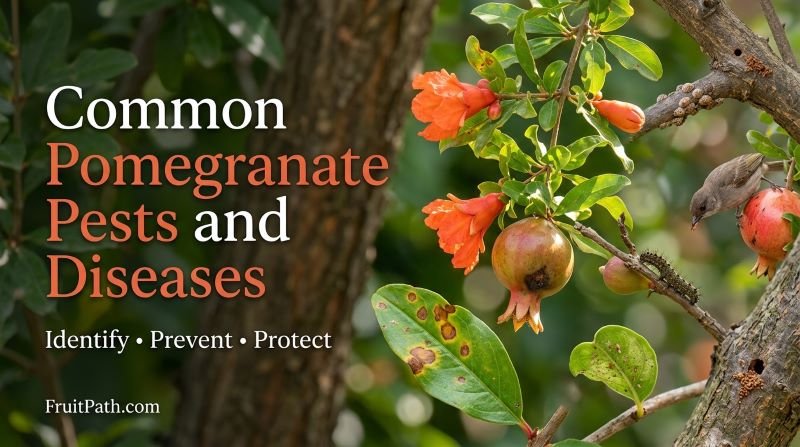
Common Pests and Diseases:
Most pomegranate problems are small, but a few matter.
- Anthracnose. UF/IFAS calls it Florida’s most destructive disease. At least three sprays a year of neutral copper fungicide can reduce it.
- Fruit rots and leaf spot. Epic Gardening names Alternaria, Aspergillus, and Botrytis. Prune damaged branches and clean your tools between cuts.
- Scale and mites. UF/IFAS says these cause little damage. A winter oil spray handles scale. Sulfur dust in early June helps with mites.
- Borers. UF/IFAS says tree borers can kill trees.
- Pomegranate butterfly. Epic Gardening recommends treating it with Bacillus thuringiensis.
- Birds. Use netting on ripening fruit.
Local pests vary, so ask your local extension office what is common in your area.
How Many Pomegranate Trees Per Acre?
Short answer: About 134 trees at wide spacing and about 200 at closer spacing. Some growers go higher.
An acre is 43,560 square feet. The number of trees depends on how far apart you plant them.
| 18 ft × 18 ft | about 134 | University of Georgia (traditional) and UC cost study (2010) |
| 12 ft × 18 ft | 202 | UF/IFAS Florida cost study (2017) |
| 10 ft × 15 ft | about 290 | University of Georgia says some local growers try it, but does not recommend it yet |
| 5 m × 5 m (about 16 ft) | about 160 (my math) | India’s National Horticulture Board calls this the normal spacing; its cost estimate uses 200 plants per acre |
The plants-per-acre numbers for the first two rows come from their sources. The 290 and 160 figures come from the spacings I worked out, so treat them as rough estimates.
Why not just plant more? Crowded trees compete for sun, water, and air. Georgia says to be careful with tight spacing. Closer planting may give more fruit sooner, but it can also mean more disease and harder work. Choose the spacing that fits your soil, climate, and variety, and ask a local extension office.
Is Pomegranate Farming Profitable?
Short answer: It can be, but not for everyone and not right away. Profit depends on your yield, price, costs, and how long you can wait.
Here is what the sources show. These are examples from different places and years, not promises. I am not a financial advisor, so use this as background, not as advice.
- Years before income. Trees bear a little in year 2 or 3, and full crops come around year 5 or 6.
- Costs go up front. UF/IFAS (Florida, 2017) puts establishment at about $4,028 per acre, plus about $ 4,028 per acre, plus about $ 1,030 per acre each year for fertilizer, weed control, and pruning. The authors say their sample was small, six growers in 2014, and the costs are incomplete.
- Disease and weather matter. Splitting, rots, and heavy rain at the wrong time can cut the sellable crop.
- Prices change. Every number below depends on the price the grower assumed.
Because this is a big topic, the next section gives the numbers one by one.
Pomegranate Farming Profit Per Acre:
Short answer: There is no single number. The examples below range from small profits per acre to large incomes, depending on location, year, and yield.
| UC Cooperative Extension cost study | Southern San Joaquin Valley, California, 2010 | 400 boxes of 28 lb in a mature orchard (year 7 and later) | Price of 18 boxes.Totalcostof18abox.Total cost of 5,951 per acre per year. Net return of $1,249 per acre above total cost. |
| India’s National Horticulture Board model project | India, data runs to about 2001 to 2002, report undated | 4 tonnes in year 5, rising to 7 tonnes by year 8 | Fruit valued at Rs 15,000 per tonne. Project cost Rs 1.75 lakh per acre. Gross profit about Rs 68,800 per acre by year 8. Payback about 4.2 years in its 15-year model. |
| ICAR National Research Centre on Pomegranate, farmer stories | Maharashtra, Karnataka, and Andhra Pradesh, around 2009 to 2010 | About 3 to 20 tonnes, depending on the farm | Farmers reported income of about Rs 3 to 7 lakh per acre and yearly costs of about Rs 30,000 to Rs 2.5 lakh per acre. |
A lakh is 100,000 rupees. Rs 1.75 lakh is Rs 175,000.
How to read the table:
- The California study shows a thin profit. At 18 boxes, a full orchard cleared 1,249 per acre after all costs. Lower prices or yields would shrink it.
- The India model is old. It uses early-2000s prices and costs, and it reports “gross profit,” not net profit after every cost.
- The farmer stories are self-reported. The ICAR center doesn’t provide a profit figure for any farmer. I also found some numbers in that document that don’t add up, so use them only to show how wide the range is.
- None of these match your situation exactly. Prices, labor, water, and land costs vary widely by location and year.
Before you plant an orchard, ask your local agriculture or extension office for current yield and price data. Visit a few growers in your area. Work out your own costs, including water, labor, spraying, and picking. Plan for the first years with no real income. Start small if you can.
What to Do With Your Harvest:
Once the fruit is ripe, picked, and ready, here is what comes next.
- Learn how to cut a pomegranate without staining your shirt.
- Keep it fresh with our storage guide.
- Check the nutrition facts and see if you can eat the seeds (yes, you can).
Frequently Asked Questions:
How long does a pomegranate tree take to bear fruit?
First flowers and a few fruits often come in the second or third year. Full production usually comes around year 5 or 6. Young trees often drop their first fruits, which is normal.
How long does it take for pomegranate fruit to grow?
Fruit ripens about 5 to 7 months after the flowers bloom, depending on weather and variety. It does not ripen after picking, so leave it on the tree until it is ready.
What are the growth stages of a pomegranate plant?
The tree roots and grows in year one, flowers in year two or three, gives a small first harvest around year three, and reaches full production around year five or six. After that, it follows a yearly cycle: rest in winter, bloom in spring, fruit growth in summer, and harvest in fall.
How long does a pomegranate tree live?
Many decades. The University of Georgia says trees can live up to 200 years. For farm planning, a California cost study assumed a 25-year working life for an orchard.
What climate does a pomegranate tree need?
It likes hot summers, cool winters, and dry weather during fruit growth. Most types grow outdoors in USDA zones 8 to 11, and some in zone 7 with shelter. A dormant tree can be badly hurt at about 12°F (-11°C). Humid weather during fruit setting can hurt fruit quality.
How big does a pomegranate tree get?
It is usually a bushy shrub 6 to 12 feet tall. You can train it into a small tree up to 12 to 20 feet tall. Dwarf types like ‘Nana’ stay around 3 to 4 feet.
Can you grow a pomegranate tree in a pot?
Yes. Pick a dwarf type and a pot at least 20 inches deep with drainage holes. Use a free-draining mix, and bring the pot into an unheated garage or a bright, cool spot before freezing nights—indoor trees rarely fruit.
How often should you water a pomegranate tree?
Aim for about 1 inch of water a week, counting rain. Water regularly in the first season, then less often but more deeply. Keep the water steady, because sudden changes can split the fruit.
Why is my pomegranate tree not fruiting?
The most common reasons are a young tree, too little sun, uneven watering, heavy pruning, poor pollination, or a flowering-only variety. Trees usually flower in year two or three. If there is no fruit by year five, check the sun, water, and variety.
Why do pomegranates split open on the tree?
Mostly because of uneven watering. A dry spell followed by heavy watering can make the fruit swell too fast. Big temperature swings, poor soil, overripe fruit, and a fungus called heart rot can also cause splitting.
Do you need two pomegranate trees to get fruit?
Not usually. Epic Gardening says the flowers are often self-pollinating. Bees and hummingbirds can raise yield, and you can hand-pollinate with a small paintbrush.
How do you plant pomegranate seeds?
Roll the seeds in a paper towel to remove the juicy part, rinse them, and let them dry. Sow them half an inch to an inch deep in moist potting mix at 75 to 85°F. The fruit will not match the parent tree, so cuttings are the better choice if you want a certain variety.
How many pomegranate trees per acre?
About 134 trees at 18-by-18-foot spacing, and about 200 at 12-by-18-foot spacing. Some growers try closer spacing, but sources urge caution. Spacing depends on your soil, climate, and variety.
Is pomegranate farming profitable?
It can be, but it takes years to reach full crops and depends on yield, price, and costs. A 2010 California study showed a thin profit of $1,249 per acre for a mature orchard, while farmers in India reported much higher incomes. Check local numbers before you invest.
How much profit can you make per acre of pomegranates?
There is no single number. In the examples I found, a mature California orchard netted about $1,249 per acre in 2010, and an Indian model project showed a gross profit of about Rs 68,800 per acre by year 8. Prices, costs, and years differ, so get current local data.
Final Thoughts:
A pomegranate tree is a beautiful, tough plant if you give it what it likes: full sun, drainage, steady water, hot summers, and cool winters. Be patient. The first flowers may take two or three years, and full crops may take five or six. And if winters are cold where you live, a dwarf tree in a pot is a good choice.
If you are thinking about farming, treat the profit numbers as a starting point. Get current prices and costs from people near you before you plant an orchard.
Once the fruit comes in, you will want to know when it is ready. Read how to see if a pomegranate is ripe, or go back to the complete pomegranate fruit guide.
Sources:
University of Georgia Extension: Pomegranate Production, Circular 997 (2022) · UF/IFAS Extension: The Pomegranate (revised 2018) · UF/IFAS: Growing Pomegranates in Florida, Establishment Costs and Production Practices (2017, reviewed 2025) · UC Cooperative Extension: Pomegranate Sample Costs, San Joaquin Valley South (2010) · UF/CREC: Pomegranate propagation · India National Horticulture Board: Pomegranate model project report · India National Horticulture Board: Pomegranate crop guide (climate) · ICAR National Research Centre on Pomegranate: farmer success stories · Epic Gardening: How to Plant, Grow, and Care for Pomegranate Trees (updated December 2025) · Epic Gardening: 7 Reasons There’s No Fruit on Your Pomegranate Tree (2024) · Gardener’s Path: Pomegranate fruit splitting (2023) · Garden.org: How to grow pomegranates · Grow Organic: How to Grow a Pomegranate Tree (2026) · California Rare Fruit Growers: Pomegranate