
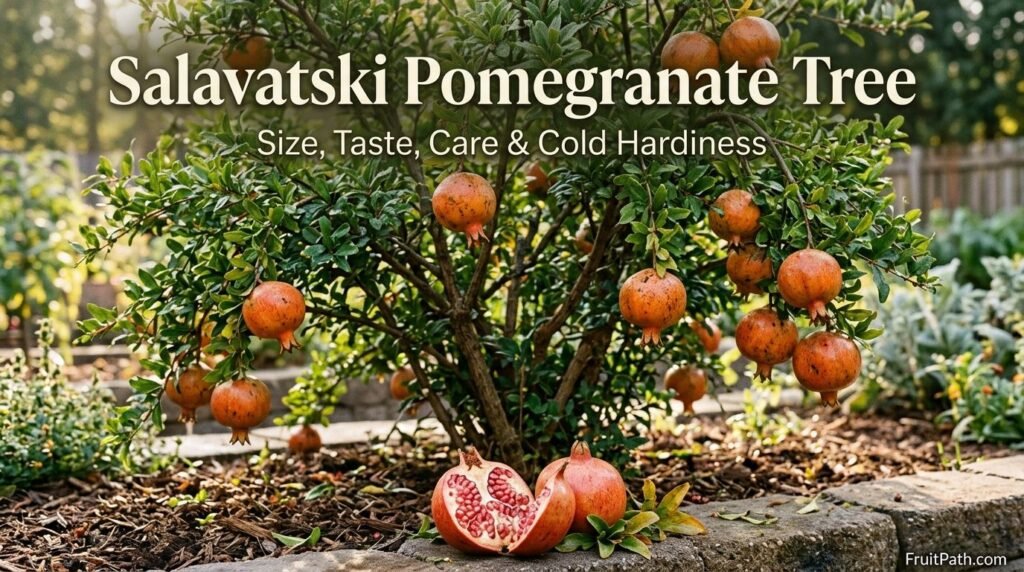
Most pomegranate trees want mild winters. But if you live where it freezes, you may have heard of one named Salavatski. Nurseries sell it as a cold-hardy pomegranate that handles winters most others cannot.
Is that true? In this guide, you will see what sellers and growers say about the Salavatski pomegranate tree: its size and height, taste, seeds, care, cold hardiness, and where to buy it, including in Canada and Ontario. You will also see where the sources disagree, because they often do.
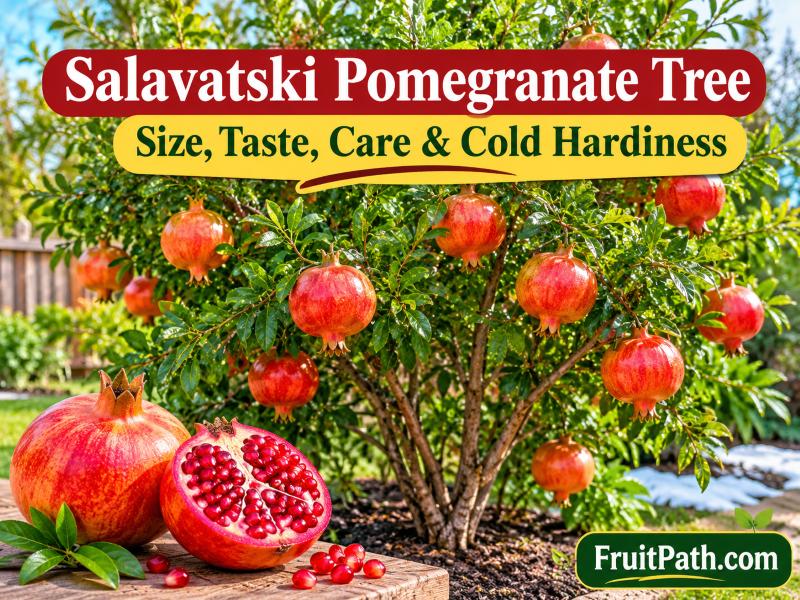
Quick answer: Salavatski is a pomegranate variety sold as cold-hardy. Sellers say it is a shrub that grows about 6 to 15 feet tall, depending on the source. It is self-fertile, so one plant can set fruit. Growers report that it can die back to the roots at about -2°F to -5°F, then regrow. We found no university test of its cold hardiness, and no report of fully ripe fruit from Canada. Treat the zone claims as seller claims.
- Key Takeaways:
- What Is the Salavatski Pomegranate?
- Salavatski Pomegranate Tree Size and Height:
- Salavatski Pomegranate Taste:
- Salavatski Pomegranate Seeds:
- Salavatski Pomegranate Care:
- How Cold-Hardy Is a Salavatski Pomegranate?
- Salavatski Pomegranate in Canada:
- Salavatski Pomegranate in Ontario:
- Salavatski Pomegranate Tree for Sale: Where to Buy:
- Is Salavatski Self-Fertile, and When Does It Fruit?
- Salavatski vs Wonderful: Which Should You Grow?
- Frequently Asked Questions:
- Final Thoughts:
- Sources/Refrences:
Key Takeaways:
- Size: sellers list a shrub from 6 to 15 feet tall. Pruning can keep it smaller.
- Taste: a University of Florida guide rates the flavour “very good.” One seller calls it sweet-tart.
- Self-fertile: yes, so you only need one plant.
- Cold: sold for zones 6 or 7 and up. Growers report root dieback at -2°F to -5°F.
- Canada and Ontario: possible in a pot or a very sheltered spot, but I found no report of ripe fruit grown outdoors in Canada.
- Seeds: seedlings do not match the parent plant, so buy a plant if you want true Salavatski.
What Is the Salavatski Pomegranate?
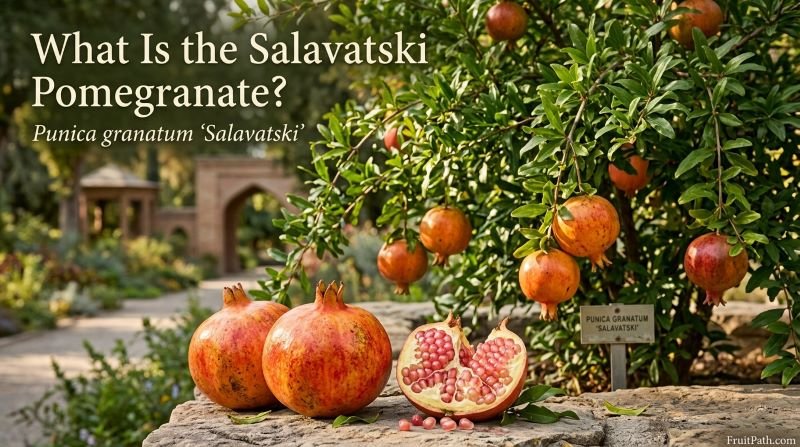
Salavatski is a named pomegranate variety (Punica granatum ‘Salavatski’). Some sellers also call it the “Russian” pomegranate. Its origin depends on the source.
- The U.S. Department of Agriculture’s plant germplasm record lists it as accession PI 483121. It says the plant was collected in the former Soviet Union in 1976 and donated in 1982 by a plant genetics station in Turkmenistan. It also labels the name as unverified.
- The nursery Raintree says it was “originally imported from Afghanistan” and introduced by Dr Gregory Levin.
These two origins don’t match, and I didn’t find a source that settles it.
For the bigger picture of pomegranate types, see our guide to pomegranate varieties.
Salavatski Pomegranate Tree Size and Height:
Short answer: A shrub, usually about 10 feet tall, but sellers list anything from 6 to 15 feet.
| Source | Height | Width or spacing |
|---|---|---|
| Raintree Nursery | 10 to 12 feet | Not listed |
| Sow Exotic | 10 to 15 feet | 8 to 12 feet wide. Space plants 10 to 12 feet apart. |
| Phoenix Perennials (British Columbia) | Text says “up to 10 feet.” Spec fields say 6 to 10 feet. | 5 to 8 feet wide |
| Edible Landscaping | Calls it a shrub | Space plants 8 to 10 feet apart |
What growers report. Customer reviewers on the Edible Landscaping page describe a plant about 10 feet tall after several years in the ground, a plant that never passed 5 feet in a pot, and another that was only about 2 feet tall after two years. A Growing Fruit forum post suggests training it as a bush with 3 to 6 main trunks and topping them to control height.
Size depends on climate, age, pruning, and whether it dies back in winter. A plant that freezes to the ground every year will stay much smaller than the numbers above.
Salavatski Pomegranate Taste:
Short answer: Reports are good, but few sources describe the taste in detail.
- The University of Florida’s pomegranate cultivar guide, based on fruit grown in Florida from 2010 to 2016, rates the flavour as “very good.”
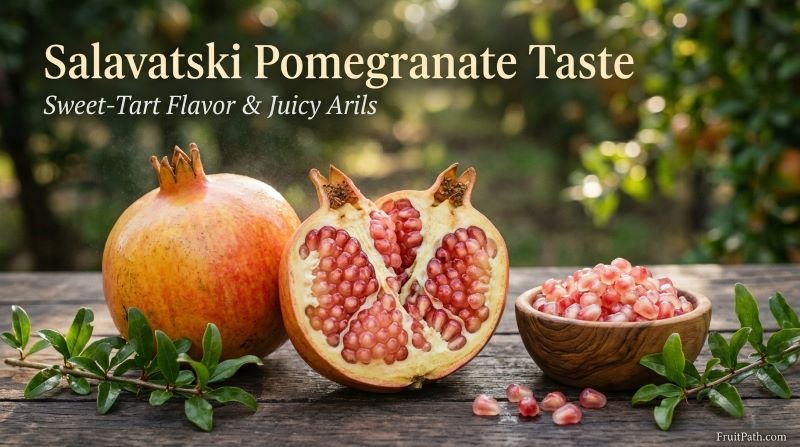
- Sow Exotic says the arils (the juicy seeds) are sweet-tart.
- A Growing Fruit forum post calls the fruit “delicious.”
- A customer reviewer on Edible Landscaping said the fruit was as good as or better than store-bought fruit.
I did not find a sugar measurement (Brix) for Salavatski, so I cannot tell you how sweet it is compared with other varieties. Taste also changes with climate and how ripe the fruit is when picked. Our guide on how to see if a pomegranate is ripe can help.
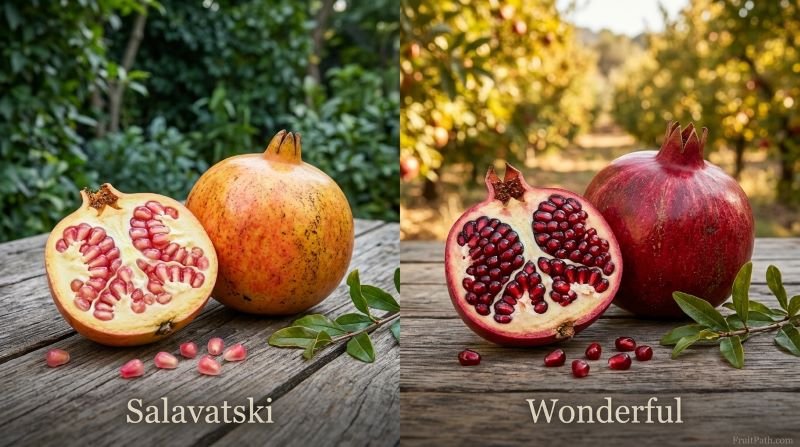
Descriptions of the fruit itself also differ. The Florida guide says the peel is mostly yellow with light pink arils. Edible Landscaping and Raintree say orange-red skin and red arils. Phoenix Perennials says the fruit is yellow to orange-red. I don’t know why there’s a difference.
Salavatski Pomegranate Seeds:
People searching this phrase usually mean one of two things.
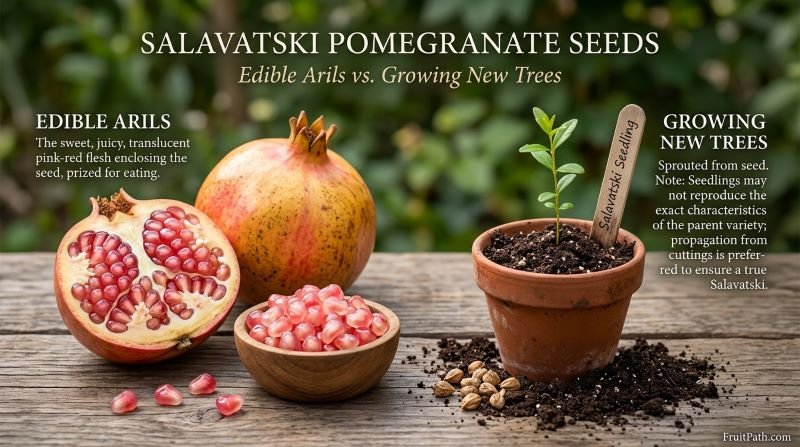
1. The seeds inside the fruit. Pomegranate “seeds” are the juicy arils, each with a small seed inside. Descriptions of how hard the inner seed is differ:
- The University of Florida guide rates the seed hardness as medium.
- Edible Landscaping calls it a hard-seeded variety.
- Raintree describes the seeds as both “hard” and “crunchy, juicy.”
You can eat the seeds. See our guide on whether you can eat pomegranate seeds.
2. Seeds for growing a new plant. This is not the best way to get a Salavatski.
- The University of Florida says plants grown from pomegranate seed do not come true to type. Cuttings reproduce the parent plant.
- That means a plant from seed may not match Salavatski’s size, fruit, or cold hardiness. A grower on a pomegranate forum reported that his Salavatski seedlings die back to the ground each winter and resprout. This is one report, not a trial.
- If a seller offers “Salavatski seeds,” I cannot tell you whether the seeds are true to the variety. Plants grown from cuttings are the safer choice.
If you still want to try seeds, our pomegranate tree guide has the steps and warm temperature range for sprouting them.
Salavatski Pomegranate Care:
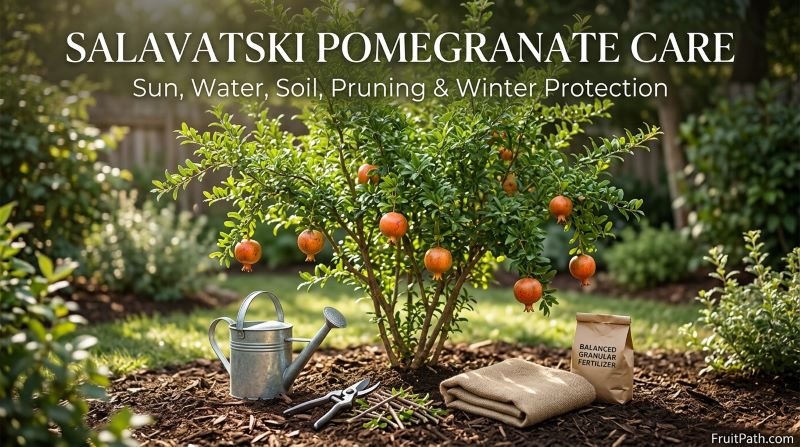
Short answer: Full sun, well-drained soil, steady water the first year, light pruning, and protection from winter wind and cold.
- Sun: Full sun. Sow Exotic says at least 6 to 8 hours of direct sun a day. Edible Landscaping rates its sun tolerance as excellent and its shade tolerance as fair.
- Soil: Well-drained. Edible Landscaping rates its tolerance of wet soil as poor. Sow Exotic gives a pH of 5.5 to 7.5.
- Water: Sow Exotic says to water regularly in the first year, and that it is drought-tolerant once established. It says occasional deep watering during fruiting improves yield and quality. Our tree guide explains how uneven watering can split fruit.
- Fertiliser: Sow Exotic suggests a balanced, slow-release fertiliser in early spring. Go light.
- Pruning: Prune lightly in late winter or early spring, remove dead or damaged branches, and thin dense growth.
- Wind: Edible Landscaping says it is best to plant out of winter winds, especially for younger plants.
- Young plants: Sow Exotic says to cover young trees with frost cover if needed. The University of Florida says young pomegranates must be protected until established, which it defines as the first two years.
- Pests and diseases: Sow Exotic lists aphids, scale, and mealybugs, which you can treat with neem oil or insecticidal soap. It also lists leaf spot and root rot, mostly from too much water or waterlogged soil.
- Pots: Edible Landscaping reviewers and a forum post say it can grow in a container. See our guide on growing a pomegranate in a pot.
For general planting steps, read how to grow a pomegranate tree.
How Cold-Hardy Is a Salavatski Pomegranate?
Short answer: Sellers claim zone 6 or 7 and up. Growers report that it can die back to the roots in the single digits and below zero.
What sellers say:
- Edible Landscaping: Zones 7 to 10. It says the plant reportedly survived -6°F once, and that dieback typically starts in the single digits, especially below about 2°F.
- Raintree: Zone 7, or zone 6B with winter protection. It says the tree can withstand temperatures below 0°F.
- Phoenix Perennials: “Zone Hardiness: 6-10.” It does not say whether this is the Canadian or U.S. system.
- Sow Exotic: Zones 6 to 11, and tolerates temperatures “as low as 10°F.” That is much warmer than the other claims, so it does not match the others.
What growers report on the Pomegranate Bazaar forum:
| Grower report | Result |
|---|---|
| Western North Carolina (zone 7b) | One plant had no damage. Another died to the roots after a day that reached -2°F. The poster thinks slope position made the difference. |
| Detroit area (zone 6b) | A plant went through a winter that reached -5°F, died to the root, and sprouted again from the base in late summer. |
| Southern Indiana (zone 6b) | The plant had no dieback in mild winters and fruited after five years. Polar vortex winters later killed it. His seedlings now die back to the ground each winter and resprout. |
These are single stories, not trials. A forum poster also said that warm spells followed by freezing, which wake the plant up early, can do more harm than a steady deep freeze.
The fair warning. The University of Florida’s cultivar guide says that sorting varieties by cold hardiness “is unproven in Florida.” I found no university trial of Salavatski’s hardiness. A plant that dies back to the roots every winter will stay small, and I found no source on how well it fruits under those conditions.
Salavatski Pomegranate in Canada:
Short answer: You can try it, but expect dieback outdoors. Most of Canada is colder than the places growers report success.
Check which zone system a seller uses. Canadian and U.S. hardiness zones are not the same. Garden Betty (February 2025) explains that U.S. zones use only the average coldest winter temperature, while Canadian zones combine seven climate factors, including frost-free period, rainfall, snow depth, and wind. A seller’s “zone 6” could mean either one.
What Canadian growers report. On a University of British Columbia Botanical Garden forum, posters in British Columbia describe plants flowering heavily and setting fruit that turned red but did not fully ripen before fall chill and rain. Some of those plants were not clearly identified as Salavatski. Sheltered spots, like a south-facing wall or under eaves, were the main protection methods. I didn’t see any poster report of fully ripe fruit grown outdoors in Canada.
Where to find it in Canada:
- Phoenix Perennials (British Columbia) has a page on Salavatski. It lists the plant as a multi-stemmed shrub with orange-red flowers, but the page doesn’t say whether it ships across Canada.
- A page titled “‘Salavatski’ Pomegranate Trees for Sale in Canada” on westcoastplants.ca appeared in my search. So check the listing for stock and shipping.
- If you buy from a U.S. seller, ask if they ship to Canada. The Canadian Food Inspection Agency may regulate plant imports. Please check the current rules before ordering.
Salavatski Pomegranate in Ontario:
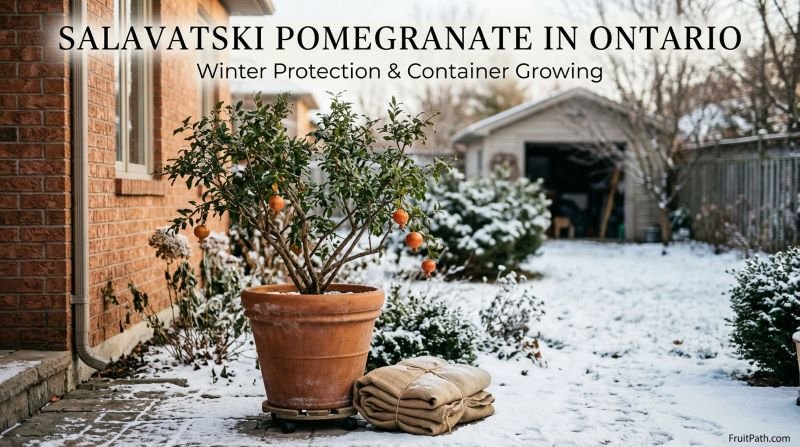
Short answer: Outdoors, it is a gamble. A pot you can move into an unheated garage or shed is the safer plan.
I found no report of a Salavatski grown outdoors in Ontario. Here is what I did find.
- A forum question. On the UBC Botanical Garden forum, a gardener in southern Ontario (zone 6a) asked about the minimum zone for pomegranates. Another poster suggested zone 7 or warmer, but that was an unverified estimate.
- Nearby U.S. reports. The Detroit-area grower (zone 6b), just across the border from southwestern Ontario, lost his plant to the roots at -5°F, and it regrew from the base. That is the winter much of southern Ontario can see, though I did not check Ontario winter lows for this guide.
- Pot growing. Growers in cold areas keep dwarf or container pomegranates in an unheated garage or bright, cool space over winter. See our tree guide for the steps.
If you want to try it in Ontario:
- Plant in a pot, or plant in the ground against a south-facing wall, out of the wind.
- Protect it for the first two winters.
- Expect some loss in a hard winter. Do not expect a big fruit crop.
- Start with one plant before you spend more.
Salavatski Pomegranate Tree for Sale: Where to Buy:
Several nurseries list Salavatski. Stock and shipping change, so I am not giving prices or promising availability.
- U.S. sellers that listed it in my search: Edible Landscaping, Raintree Nursery, Ison’s, Chestnut Hill Tree Farm, Sow Exotic, and Logee’s.
- Canada: Phoenix Perennials lists it. See the Canada section above for other leads.
Before you buy, check:
- The name. Make sure the label says Salavatski, and ask how the plant was propagated. Cuttings or tissue culture keep it true to type.
- Size and age. Smaller plants cost less but take more protection.
- The seller’s own winter results. Ask what they saw in a hard winter and which zone system they use.
- Shipping time. Plants should not arrive in freezing weather.
- Return policy. Ask what happens if it dies the first winter.
Is Salavatski Self-Fertile, and When Does It Fruit?
Self-fertile: Yes. Raintree, Edible Landscaping, and Phoenix Perennials all say so. You only need one plant, though bees and hand-pollinating can help.
Time to first fruit: Sources vary.
- Sow Exotic says it fruits within 2 to 3 years of propagation.
- A reviewer on Edible Landscaping said the plant flowered in its first spring in the ground and set fruit around the third year.
- The Indiana grower above got his first fruit after five years.
- The University of Florida guide describes it as “early bearing” with “very strong consistent cropping,” as observed in Florida.
Ripening: Raintree says late fall. A Growing Fruit post describes red fruit in early fall. Climate decides, and fruit ripens about 5 to 7 months after bloom. Our pomegranate tree guide covers the timeline.
Salavatski vs Wonderful: Which Should You Grow?
Short answer: Salavatski if cold is your main worry. Wonderful if you live in a warm climate and want the main store variety.
- Cold: Salavatski is sold for zone 6 or 7 and up. Garden.org lists ‘Wonderful’ as hardy to zone 8.
- Fruit size: Edible Landscaping and Raintree say Salavatski fruit is about the size of Wonderful.
- Taste and seeds: Reports vary, as shown above. Wonderful is the main variety sold in U.S. stores. Our varieties guide covers it.
Frequently Asked Questions:
What is a Salavatski pomegranate?
It is a named pomegranate variety that nurseries sell as cold-hardy. The USDA germplasm record says it was collected in the former Soviet Union in 1976 and donated by a Turkmenistan station. One nursery says it came from Afghanistan, so sources disagree on the origin.
How big does a Salavatski pomegranate tree get?
It is a shrub. Sellers list 10 to 12 feet at Raintree, 10 to 15 feet tall and 8 to 12 feet wide at Sow Exotic, and 6 to 10 feet tall at Phoenix Perennials. Pruning can keep it smaller, and a plant that dies back each winter stays smaller too.
What does Salavatski pomegranate taste like?
The University of Florida guide rates the flavour “very good,” and Sow Exotic calls it sweet-tart. No source I found gives a sugar measurement. Taste varies with climate and ripeness.
Can you grow Salavatski pomegranate from seed?
You can try, but seedlings do not come true to type, according to the University of Florida, so the plant may not match Salavatski. Cuttings or a nursery plant are the safer way to get the real variety.
How do you care for a Salavatski pomegranate?
Give it full sun, well-drained soil, regular water in the first year, and light pruning in late winter or early spring. Plant it out of winter wind, and protect young plants from cold for the first two winters.
How cold-hardy is Salavatski pomegranate?
Sellers claim it’s hardy in zone 6 or 7 and up. Growers report plants dying to the roots at about -2°F and -5°F, then regrowing. I found no university test of its hardiness, so protect young plants and expect possible dieback in hard winters.
Can you grow a Salavatski pomegranate in Canada?
You can try, mostly in a pot or a very sheltered spot. Canadian growers in British Columbia report fruit that colored but did not fully ripen, and I found no report of fully ripe fruit grown outdoors in Canada. Check which zone system a seller uses, because Canadian and U.S. zones differ.
Can you grow a Salavatski pomegranate in Ontario?
I found no report of one grown outdoors in Ontario. A Detroit-area grower in zone 6b lost his plant to the roots at -5°F, and it regrew. A pot that you can move into an unheated garage over winter is the safer choice.
Where can you buy a Salavatski pomegranate tree?
Several U.S. nurseries list it, including Edible Landscaping, Raintree Nursery, and Ison’s. In Canada, Phoenix Perennials lists it. Ask about propagation method, plant age, shipping season, and whether the seller ships to you.
Is Salavatski pomegranate self-fertile?
Yes. Raintree, Edible Landscaping, and Phoenix Perennials all say it is self-fertile, so one plant can set fruit. Pollinators or hand-pollinating with a paintbrush can still help.
How long does Salavatski take to fruit?
Sources vary. Sow Exotic says 2 to 3 years, a reviewer saw fruit around year three, and an Indiana grower got fruit after five years. Fruit ripens about 5 to 7 months after bloom, in early to late fall depending on your climate.
Final Thoughts:
The Salavatski pomegranate tree is worth a look if you live where most pomegranates will not survive the winter. It is sold as cold-hardy, it is self-fertile, and growers say the fruit tastes good. But most of the hardiness claims come from sellers, and growers report plants dying to the roots in hard winters. In Canada and Ontario, plant in a pot or a very sheltered spot, and don’t count on a big crop.
Plant it in a sunny spot, protect it for the first two winters, and buy a named plant instead of seeds. For planting steps, watering, and fruit timing, read our pomegranate tree guide or go back to the complete pomegranate fruit guide.
Sources/Refrences:
USDA Germplasm Resources Information Network: Salavatski, PI 483121 · University of Florida (UF/IFAS CREC): Cultivar Selection Guide for Florida-Grown Pomegranates (observations 2010 to 2016) · UF/CREC: Pomegranate propagation · Edible Landscaping: Salavatski Pomegranate · Raintree Nursery: Salavatski Pomegranate · Sow Exotic: Growing Guide, Salavatski Pomegranate · Phoenix Perennials: Punica ‘Salavatski’ · Pomegranate Bazaar forum: Cold Hardy Pomegranate Cultivars · Growing Fruit forum: Russian Pomegranate Salavatski · UBC Botanical Garden forum: Pomegranate · Garden Betty: How to Convert Between US and Canadian Plant Hardiness Zones (2025) · Garden.org: How to grow pomegranates