If you have never heard of Safou, you are about to fall in love with one of Africa’s best-kept secrets. This small, purple, buttery fruit has been feeding families across West and Central Africa for thousands of years, yet most of the world has still never tasted it. That is starting to change. Thanks to growing exports and a wave of curious food lovers, Safou (African Butter Pear) is finally getting the global attention it deserves.
In this guide, you will learn exactly what Safou is, what it tastes like, why it is so good for you, and, step by step, how to pick, store, cook, and eat it like a pro. By the end, you will understand why so many people who try Safou once end up craving it for life.
- What Is Safou? Meet the African Butter Pear:
- The African Pear Tree: Where Safou Comes From:
- What Does Safou Taste Like?
- What Does Safou Look Like?
- African Pear vs Avocado: What's the Difference?
- African Pear Nutrition Facts (Per 100g):
- Why Safou Is Becoming a Bigger Deal Worldwide
- Safou Fruit Benefits
- How to Choose the Perfect Safou (Step-by-Step)
- How to Store Safou:
- Best Flavor Pairings for Safou:
- Popular Safou Recipes to Try:
- Side Effects of African Pear (and Who Should Be Careful)
- Frequently Asked Questions About Safou:
- Final Thoughts: Why You Should Try Safou
What Is Safou? Meet the African Butter Pear:
Safou is the fruit of a tall evergreen tree called Dacryodes edulis, a member of the Burseraceae plant family. The tree is native to the humid, tropical forests of West and Central Africa, and it has so many local names that newcomers often get confused. Depending on where you are, you might hear it called:
- African pear
- African butter pear or butterfruit
- Bush pear or bush plum
- Ube (mostly in southeastern Nigeria)
- Atanga (Gabon and Equatorial Guinea)
- Nsafu or Safou (Congo, DRC, Angola)
- Prunier or safoutier (French-speaking regions)
One fun mix-up: it is easy to confuse this fruit with ube, the purple yam from the Philippines, simply because both are vividly purple and share a similar nickname in Nigeria. They are, however, completely unrelated plants from opposite sides of the world.
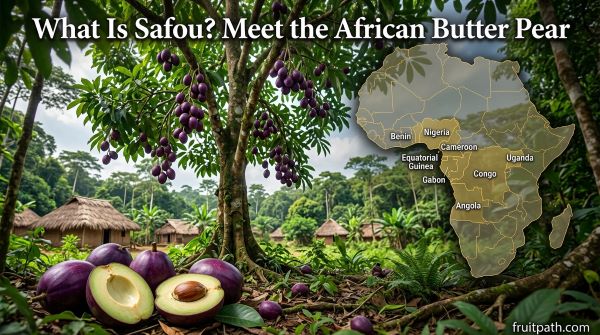
You will find Safou trees growing across Nigeria, Cameroon, Gabon, Equatorial Guinea, the Republic of the Congo, the Democratic Republic of Congo, Benin, and beyond, all the way to Angola and Uganda. In many villages, the tree is treated as sacred; even when land is cleared for farming, the Safou tree is often left standing because it is considered too valuable to cut down.
The African Pear Tree: Where Safou Comes From:
The African pear tree is a striking evergreen that can grow anywhere from 18 to 40 meters tall in its natural forest habitat. However, it typically stays closer to 8–12 meters when planted on farms and in home gardens. It has a relatively short trunk, a deep and dense crown, and pale gray bark that often shows small droplets of natural resin.
Its leaves are compound, made up of 5 to 8 pairs of glossy leaflets, and the tree produces small yellow flowers, only about 5mm across, at the start of the rainy season. Fruit follows roughly two to five months later.
Interestingly, there are two recognized varieties of the African pear tree:
- Var. edulis: Produces larger fruit and grows with stout, upright branches.
- Var. parvicarpa: Produces smaller fruit and has slender, drooping branches.
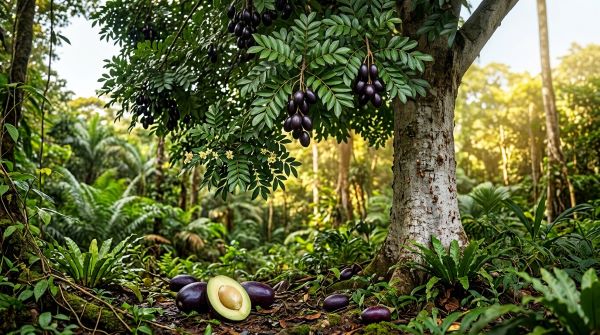
Both varieties are generally sold and eaten under the same name, Safou, so you likely will not know which one you are buying unless a grower tells you. Either way, the African pear tree adapts well to a wide range of soil types, humidity levels, and temperatures, which is part of why it has such a large natural range across the continent — and part of why it is now being tested in new growing regions like Malaysia.
What Does Safou Taste Like?
This is the question everyone asks first, and honestly, the answer depends on how you eat it.
Raw Safou has a slippery, soft texture with a sour, tangy bite and a faint aroma that reminds some people of citrus or fresh turpentine. It is not a fruit most people fall for on the first raw bite; it is closer to an acquired taste, similar to how some people need time to appreciate olives.
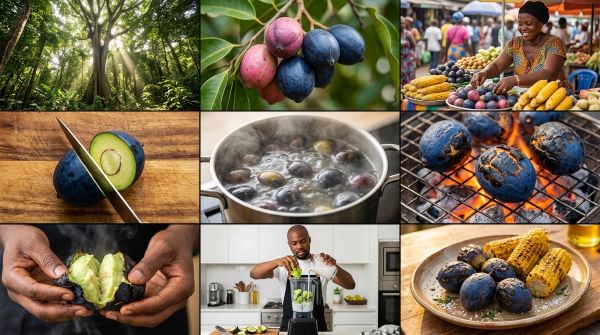
Cooked Safou is where the magic happens. Once you boil or roast it, the flavor completely transforms. The tartness fades, and what is left is a rich, buttery, savory taste with a soft, creamy texture, almost like a cross between an avocado and a roasted chestnut. This is exactly why the fruit earned its nickname, butterfruit.
What Does Safou Look Like?
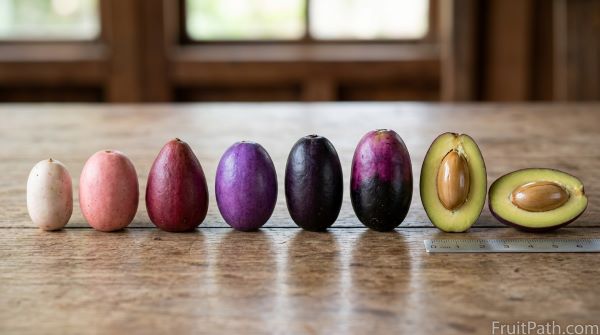
Safou fruit varies quite a bit depending on genetics and growing conditions, so do not worry if two fruits from the same tree look slightly different. In general, you can expect:
- Shape: Oblong, oval, or slightly conical.
- Size: Roughly 4 to 15 centimeters long and 3 to 6 centimeters wide.
- Skin: Thin, shiny, and waxy, often marked with small natural scars.
- Color: Ranges from pink or pale white when unripe to violet, dark blue, or almost black when fully ripe — sometimes with more than one color on a single fruit.
- Flesh: Smooth and creamy, in shades of green, pale yellow, pink, or cream.
- Seed: One large, firm, oval, light-brown seed in the center.
African Pear vs Avocado: What’s the Difference?
Because Safou is creamy, high in fat, and often nicknamed “the poor man’s avocado,” this comparison comes up constantly. Here is how African pear vs avocado actually breaks down:
| Feature | African Pear (Safou) | Avocado |
| Texture (raw) | Slippery, tangy, firmer | Smooth, mild, soft |
| Texture (cooked) | Buttery, savory | Not typically cooked |
| Common prep | Boiled or roasted | Eaten raw |
| Flavor | Sour raw, buttery cooked, citrus notes | Mild, nutty, creamy |
| Fat content | High (~22g per 100g) | High (~15g per 100g) |
| Vitamin C | Higher | Lower |
| Culinary role | Traditional African staple, cooked side dish | Global staple, usually raw in salads or spreads |
The biggest difference comes down to preparation. Avocado is almost always eaten raw, straight out of the skin. Safou, on the other hand, is traditionally cooked — boiled or roasted — before eating, which is what unlocks its buttery flavor. Nutritionally, the two are close cousins, but Safou edges ahead on Vitamin C and offers a completely different, more savory flavor profile once prepared the traditional way.
African Pear Nutrition Facts (Per 100g):
African pear nutrition facts are genuinely impressive, which is a big reason nutritionists and researchers have started paying closer attention to this fruit.
Nutrient Amount per 100g% Daily Value
| Nutrient | Amount per 100g | % Daily Value |
| Calories | 240 kcal | — |
| Total Fat | 22 g | — |
| Carbohydrates | 13.5 g | — |
| Fiber | 2.5 g | 9% |
| Sugar | 6.5 g | — |
| Protein | 4.5 g | — |
| Vitamin C | 12.5 mg | 14% |
| Vitamin A | 105 IU | 4% |
| Potassium | 450 mg | 10% |
| Magnesium | 35 mg | 9% |
Safou also contains essential amino acids, including threonine, lysine, and leucine — the building blocks your body needs for tissue repair, transporting nutrients, and healthy digestion. Its high oil content is part of what gives the fruit its buttery, avocado-like consistency, and it is a rich source of healthy fats, antioxidants, and phytonutrients such as carotenoids and flavonoids.
Why Safou Is Becoming a Bigger Deal Worldwide
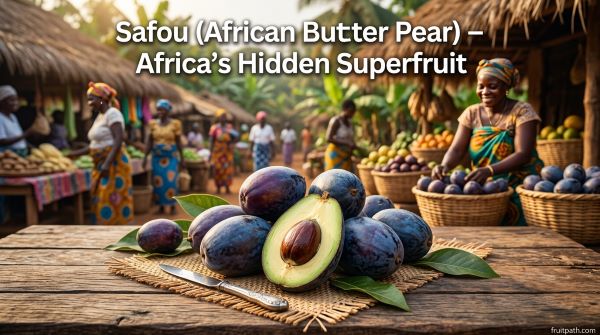
For most of its long history, Safou stayed close to home — grown in village gardens, sold at local markets, and eaten mostly by people who lived near the tree that produced it. That is changing fast. Researchers, farmers, and food exporters across Nigeria, Cameroon, and Gabon are now looking at Safou as a genuine opportunity: a nutrient-dense crop that could support rural incomes and even help address food security during lean growing seasons.
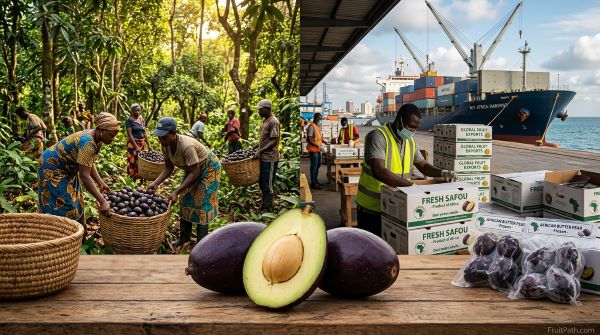
Part of the appeal is practical. Unlike crops that need heavy chemical treatment, Safou trees tend to thrive with minimal intervention, which is why so much of it is grown organically almost by default. Part of the appeal is also cultural — this is a fruit with real history behind it, not a manufactured “superfood” trend. When you buy Safou, you are supporting small-scale farmers and a food tradition that stretches back generations.
As more African food specialists build cold-chain export networks, frozen and vacuum-packed Safou is starting to reach specialty grocers and online retailers outside Africa. That is genuinely exciting news for anyone who loves discovering ingredients that most of the world has not yet caught on to.
Safou Fruit Benefits
The list of Safou fruit benefits is long, and it is a big reason more people are adding this fruit to their diet. Here are the biggest reasons:
1. Supports Heart Health:
Safou is rich in healthy fats that support cardiovascular function. Combined with its potassium content, it helps your body manage blood pressure and ease tension in blood vessel walls, which is one of the simplest things you can do for long-term heart health.
2. Aids Digestion:
With 2.5g of fiber per 100g, Safou helps keep your digestive system moving. Dietary fiber is well known for supporting regular digestion, improving cholesterol levels, and helping you feel full longer, which can also support healthy weight management.
3. Boosts Immunity
Safou delivers 14% of your daily Vitamin C, a nutrient your body relies on for immune defense, antioxidant protection, and collagen production. Vitamin C is one of those nutrients your body cannot store for long, so getting it regularly from fruit like Safou genuinely matters.
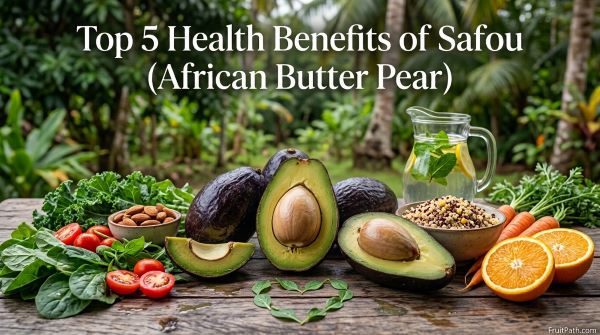
4. Supports Blood Pressure Regulation
The potassium in Safou plays a direct role in helping your kidneys manage sodium and easing pressure on your blood vessels, both of which contribute to healthier blood pressure levels over time.
5. Protects Vision and Skin
Thanks to its Vitamin A content, Safou also supports healthy eyesight, skin integrity, and general immune resilience.
How to Choose the Perfect Safou (Step-by-Step)
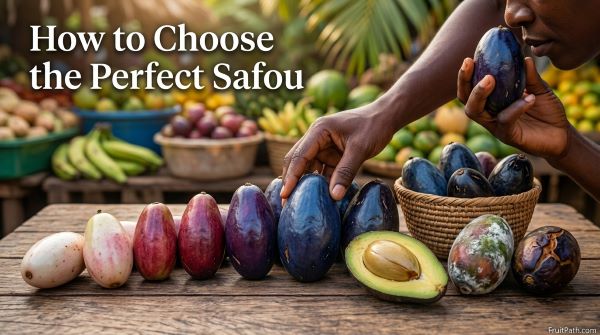
Picking a good Safou fruit is easy once you know what to look for. Follow these steps:
Step 1: Check the color. Look for fruit that has turned a deep purple or brown. This is the clearest sign of ripeness.
Step 2: Inspect the skin. Avoid any fruit with bruises, cracks, or visible mold. A few natural surface “scars” are completely normal and not a defect.
Step 3: Give it a gentle squeeze. Ripe Safou should feel slightly soft, similar to a ripe avocado, but not mushy.
Step 4: Smell it. A ripe Safou often carries a light citrus or aromatic scent. If it smells sour or fermented, skip it.
Step 5: Buy a few extra. Since genetic variation means every fruit can taste slightly different, buying a handful lets you compare and find your favorite.
How to Store Safou:
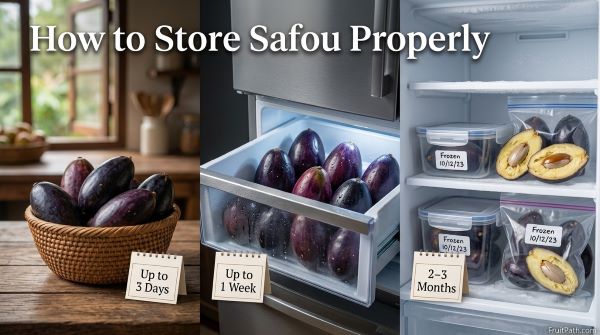
Safou fruit is highly perishable, so proper storage really matters:
- Room temperature: Keep for up to 3 days in a cool, well-ventilated spot.
- Refrigerated: Extends shelf life up to about 1 week.
- Fresh and unprocessed: Note that very fresh, unrefrigerated Safou can spoil faster — often within 1 to 5 days — so refrigeration is strongly recommended if you are not eating it right away.
- Freezing: For long-term storage, freeze whole or sliced Safou in an airtight container for 2–3 months. Thaw in the refrigerator before use, and always label your container with the date so you know exactly how fresh it still is.
- How to Eat Safou Fruit: A Step-by-Step Guide
Ready to actually cook and eat Safou? Here are the three most popular methods, explained simply.
Method 1: Boiled Safou (the classic way)
- Rinse the fruit thoroughly under running water.
- Place the whole fruit into a pot of lightly salted water.
- Bring to a gentle boil and cook for 5–10 minutes, until the flesh softens.
- Remove from the water and let it cool slightly.
- Slice the fruit open and remove the large seed.
- Serve warm, plain or with a pinch of extra salt.
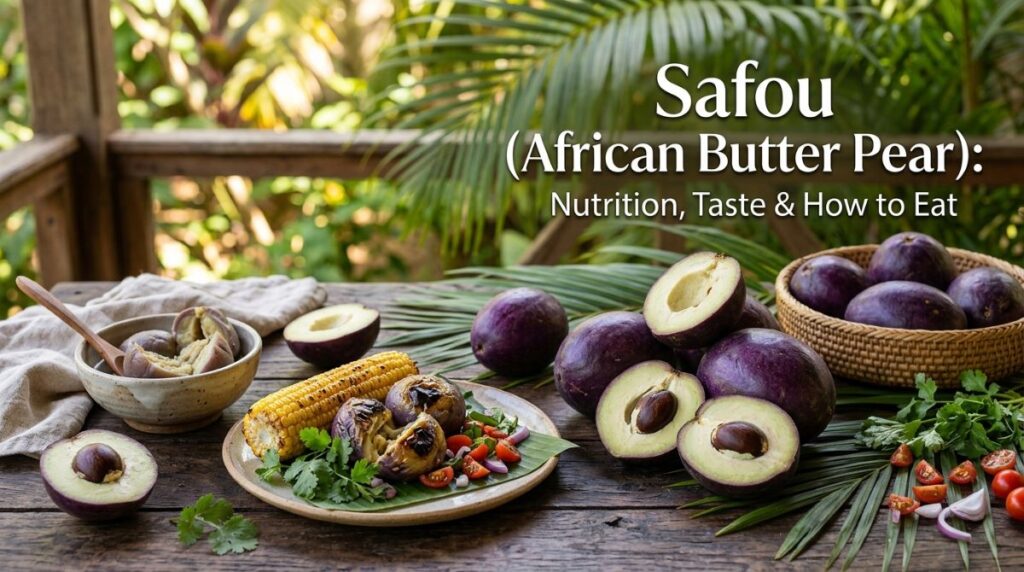
This is the most common way Safou is eaten across Nigeria and Central Africa, often paired with maize, plantains, or cassava for a filling meal.
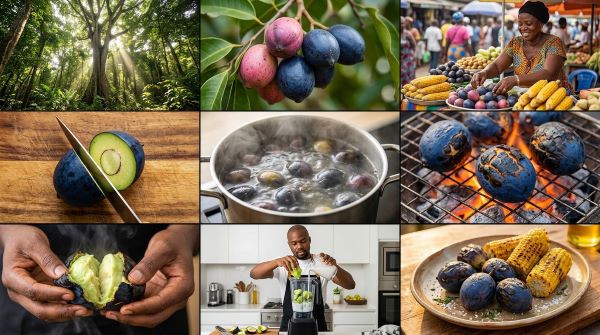
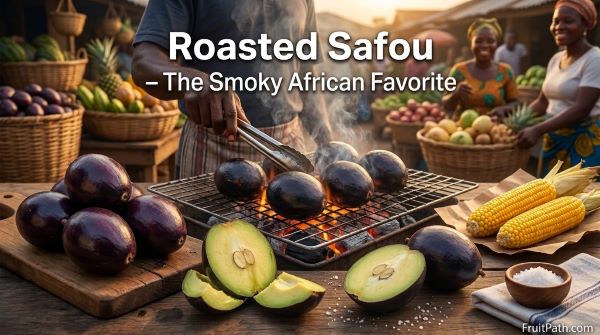
Method 2: Roasted Safou (the smoky favorite)
- Wash the fruit and pat it dry.
- Place it directly on a dry pan or over hot charcoal.
- Roast for several minutes, turning occasionally, until the skin is lightly charred.
- Let it cool for a minute, then peel back the skin.
- Remove the seed and enjoy the soft, smoky flesh with a sprinkle of salt.
Street vendors across Lagos sell Safou this exact way, often alongside roasted corn — a pairing that is genuinely worth trying at home.
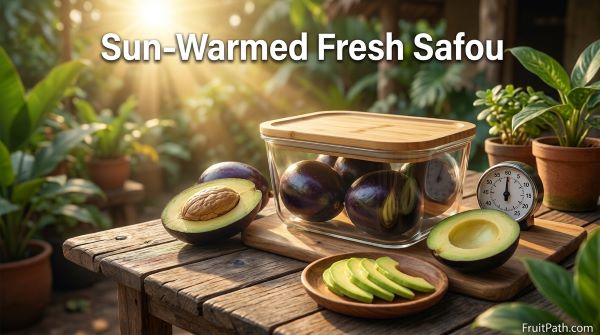
Method 3: Sun-Warmed Fresh Safou
- Place fresh, ripe Safou fruit in a sealed container.
- Set the container in direct sunlight for 15–20 minutes to gently warm the fruit.
- Slice, remove the seed, and eat as is.
This method softens the texture slightly without fully cooking it, which many people find easier to enjoy than eating it fully raw and cold.
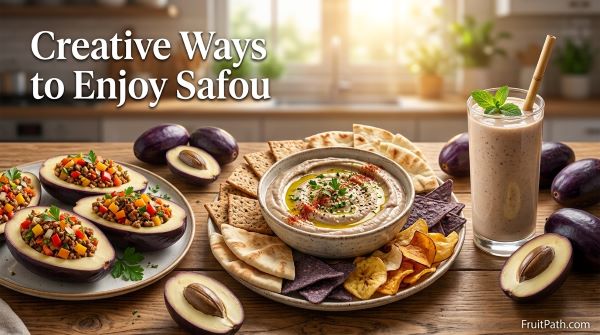
Bonus: Stuffed and Pureed Safou:
Once boiled and softened, the flesh can be stuffed with cooked meats, spices, and vegetables for a heartier dish, or blended into a smooth dip or spread and served with crisps, chips, or flatbread. Safou also blends beautifully into smoothies, adding a creamy, rich texture.
Best Flavor Pairings for Safou:
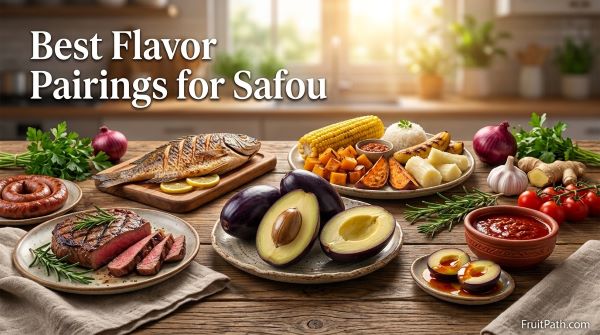
Safou’s buttery, savory flavor pairs wonderfully with:
- Tomatoes, onions, garlic, and ginger.
- Fresh herbs like parsley and rosemary.
- Grilled meats, fish, and sausage.
- Butternut squash and sweet potatoes.
- Rice, corn, plantains, and cassava.
- A drizzle of palm oil sauce for an authentic touch.
Popular Safou Recipes to Try:
- Boiled Safou with Palm Oil Sauce.
- Roasted Safou with Herbs and Spices.
- Safou and Vegetable Stew.
- Roast Tomatoes with Safou.
- Safou Smoothie.
Where to Buy Safou
Here is the good news: you no longer need to travel to West Africa to try this fruit.
Within Africa, Safou is easy to find in open-air markets, roadside stalls (often sold with roasted corn), and increasingly in supermarkets across Nigeria, Cameroon, and Gabon during peak season, which typically runs from May to August.
Outside Africa, demand has grown enough that Safou now shows up in African specialty markets in cities with large West and Central African communities — places like London, Brussels, and other parts of the UK, Belgium, Switzerland, and France. It is even being cultivated on a small scale in Malaysia. A growing number of African food importers also now sell frozen Safou online, which means you can order it and enjoy it fresh year-round, not just during the short natural season.
If you have been waiting for a sign to try this fruit finally, this is it. Order Safou today, and give this rare, nutrient-dense superfruit a place in your kitchen — your taste buds (and your body) will thank you.
Side Effects of African Pear (and Who Should Be Careful)
Safou is generally safe and gently produced, often grown organically in traditional settings with minimal pesticide use. That said, it is worth knowing the possible side effects of African pear before you dig in:
- Nut allergies: Because of its high fat content, people with nut allergies should consult a healthcare provider before trying Safou for the first time.
- Sensitive stomachs: Eating too much in one sitting can occasionally cause mild stomach upset or bloating.
- Unripe fruit: Eating Safou before it is properly ripe or cooked can make the tartness and sour flavor unpleasantly strong, and may be harder to digest.
- Preparation: Always wash the fruit thoroughly and remove the large central seed before eating — it is not edible and can be a choking hazard if swallowed accidentally.
For most people, these are the only real precautions to keep in mind. Safou is not known for serious or common side effects when eaten ripe, cooked, and in normal portions.
Fun Facts About Safou:
- Safou is sometimes called “the poor man’s avocado” because of its similar fat content and creamy texture, even though it is a completely different fruit.
- In many Nigerian communities, Safou has historically helped families get through the “hungry season” — the gap between harvests — making it a genuine survival food as well as a treat.
- Safou trees are so respected that farmers often protect them even while clearing land for new crops.
- The fruit plays a role in traditional African festivals and community celebrations.
Frequently Asked Questions About Safou:
Does African pear increase blood sugar?
Not significantly when eaten in normal portions. Safou has a moderate glycemic index of around 50, and its combination of fiber and healthy fats helps slow down how quickly sugar enters your bloodstream after eating. This means it does not cause the same sharp blood sugar spike you would get from a high-sugar, low-fiber snack.
That said, everyone’s body responds a little differently, so if you are managing diabetes or watching your blood sugar closely, it is a good idea to eat Safou in moderate portions and check in with your doctor or dietitian about how it fits into your overall diet.
Why does my stomach hurt after eating pears?
This usually comes down to a few common culprits. Pears, including African pear, contain natural sugar alcohols like sorbitol along with a good amount of fiber, and both can cause gas, bloating, or cramping if you eat a large portion at once or your gut is not used to that much fiber.
Eating the fruit before it is fully ripe is another frequent cause — unripe or raw Safou is noticeably more acidic and tart, and that acidity can irritate a sensitive stomach. In rarer cases, stomach pain after eating pears can point to a mild food sensitivity or allergy, especially in people who already react to other fruits in the same family. If the pain is severe, repeated, or comes with other symptoms like hives or swelling, it is worth checking in with a doctor.
When not to eat a pear?
There are a few situations where it makes sense to hold off. Avoid eating pears, and especially raw Safou, when it is still unripe, since the fruit is much more acidic and harder to digest at that stage. It is also wise to be cautious about eating a large portion on an empty stomach if you already have a sensitive digestive system, since the fiber and sorbitol content can trigger cramping or bloating faster that way.
People following a low-FODMAP diet or managing IBS are often advised to limit pears in general because of their natural sugar alcohol content. And, as with any fruit, if you have a known allergy or you notice your body reacting badly after eating it, that is your body telling you to skip it and speak with a healthcare provider.
Is African pear high in cholesterol?
No — African pear contains zero cholesterol. Cholesterol is only found in animal-based foods like meat, eggs, and dairy, so no plant food, including Safou, naturally contains any. What Safou does have is a notably high fat content, roughly 22 grams per 100 grams, but this is made up largely of healthy, plant-based fats rather than the saturated fats and dietary cholesterol found in animal products. In fact, the fiber in Safou may actually support healthy cholesterol levels over time by helping your body process and remove excess LDL, or “bad,” cholesterol.
What type of pear is best for constipation?
Any pear eaten with the skin on is a solid choice for constipation relief, since that is where most of the fiber is concentrated. Among common pear varieties, Bosc and Asian pears tend to rank especially high in fiber. Still, African pear, or Safou, holds its own here too, offering both fiber and a high fat content that can help keep things moving through the digestive system.
For the best results, eat the fruit ripe, drink plenty of water alongside it, and introduce it gradually if you are not used to a high-fiber diet, since adding too much fiber too quickly can sometimes cause temporary bloating instead of relief.
Final Thoughts: Why You Should Try Safou
Safou (African Butter Pear) is exactly the kind of fruit food lovers dream of discovering — rare, nutrient-packed, deeply rooted in culture, and genuinely delicious once you know how to prepare it. Whether you boil it the traditional way, roast it until smoky, or blend it into a creamy dip, this fruit rewards a little curiosity with a lot of flavor.
If you have never tried Safou before, there has never been a better time. Track down a local African market, look for it online, and give this remarkable fruit a place on your plate. Once you taste it properly cooked, you will understand exactly why it has been treasured across an entire continent for centuries.
If you are curious about more African exotic fruits, read our article: 30+ African Exotic Fruits You’ve Never Heard.